US DOLLAR
 EURO
EURO
 AUSTRALIAN DOLLAR
 CANADIAN DOLLAR
 POUND STERLING






Product Description
SEE MORE ANCIENT NEAR EASTERN ARTIFACTS
SEE MORE ANCIENT SCYTHIAN ARTIFACTS
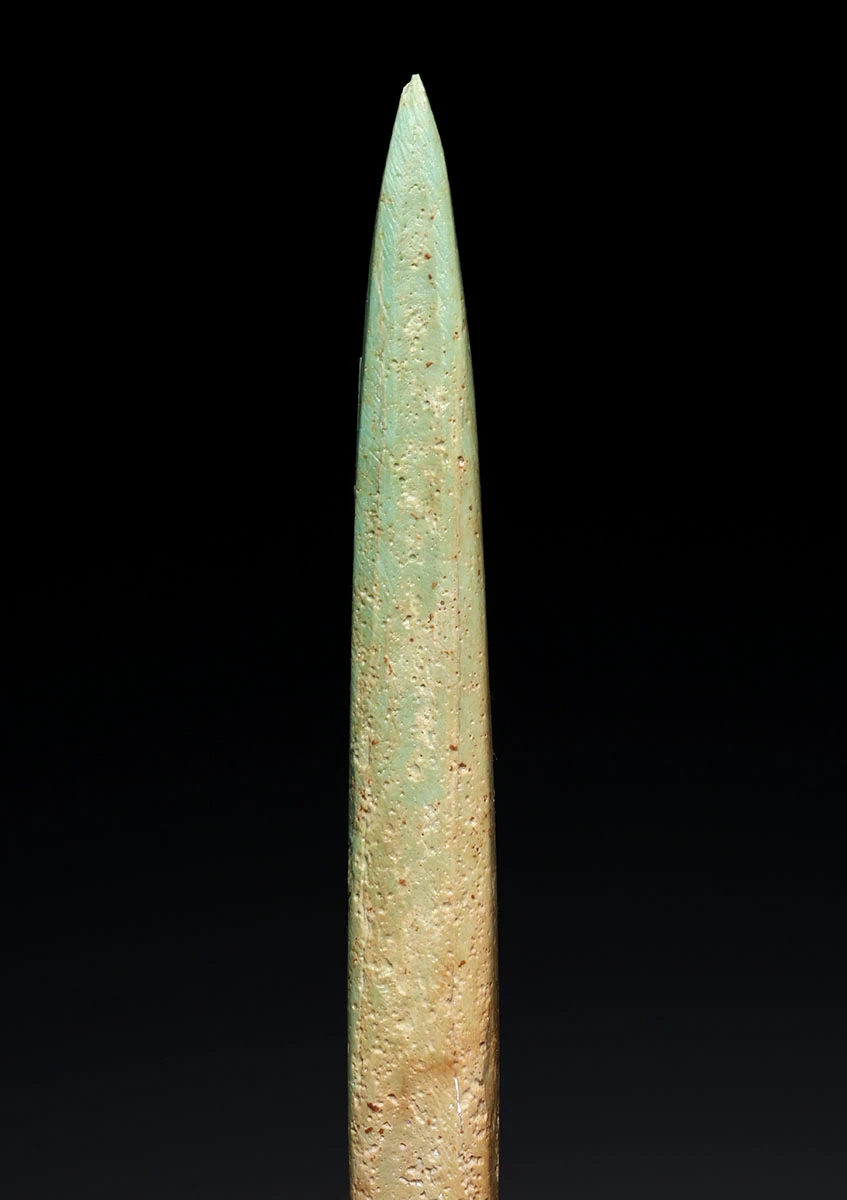
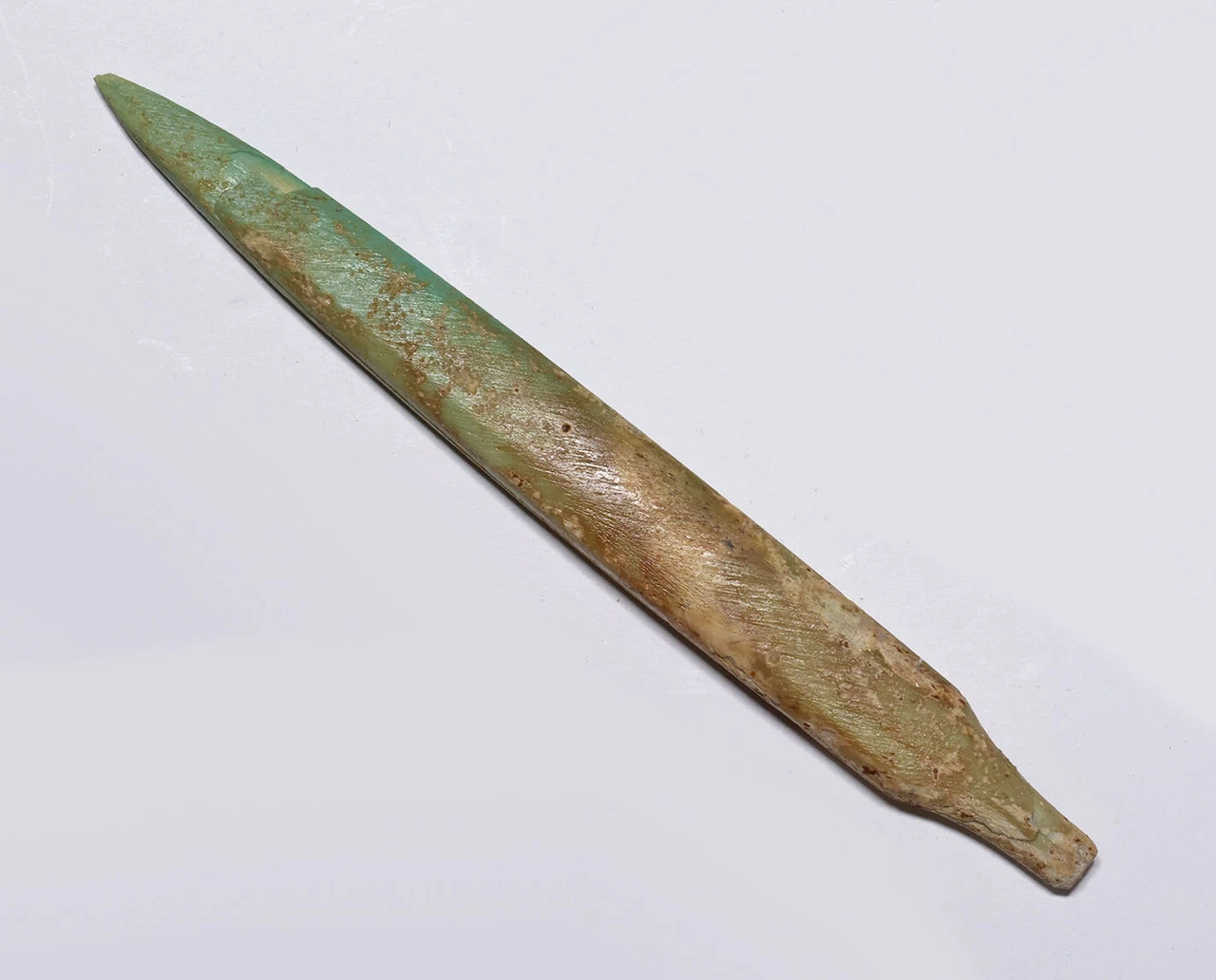
Objects from the ancient Sarmatian Eastern Scythian Empire horseback nomad culture are extremely rare and their absence in any collection, private or institutional, proves that. This is RARE large bone arrowhead from an ancient Sarmatian horseback warrior. A unique and stunning aesthetic feature is that the bone has been lightly stained an emerald green from laying next to bronze (most likely more common bronze arrowheads that were used) that patinated over the ages, before it was discovered.
The Sarmatians, Scythians and Saka, were a large confederation of ancient Iranian horse nomadic peoples who dominated the Pontic Steppe from about the 3rd century BC to the 4th century AD. These are grouped together as "East Iranians." The Sarmatians spoke an Iranian language that was derived from 'Old Iranian'. Eastern Sarmatian tribes used scale armor, and used a long lance called the contus, and bows in battle.
Made entirely of bone, this large arrowhead dates from the 3rd century BC to the 4th century A.D.. The reference list at the end of this description includes several sources scientifically documenting the use of the bone arrowhead by the Sarmatians. One unique aspect of the Sarmatians and other Eastern Scythians was the feared use of poison on their arrowheads. The porosity of a bone arrowhead versus more common bronze and later, iron, would have been absorbent to hold more of the poison. This exceptional example shows excellent preservation considering it is of an organic substance, and is complete. The original ancient grinding marks can be easily seen on some surfaces, and mineral deposits are deeply embedded in the micro-crevices - indicators only found in authentic ancient specimens. From an ex-London, England private collection acquired before 1980.
We have only a small collection of these and will never be able to acquire more, once sold.
HISTORY
The Sarmatians, Scythians and Saka, were a large confederation of ancient Iranian horse nomadic peoples who dominated the Pontic Steppe from about the 3rd century BC to the 4th century AD. These are grouped together as "East Iranians." The Sarmatians spoke an Iranian language that was derived from 'Old Iranian'. Eastern Sarmatian tribes used scale armor, and used a long lance called the contus, and bows in battle.
Originating in the central parts of the Eurasian Steppe, the Sarmatians were part of the wider Scythian cultures from Central Asia, who migrated into the territory of the Sauromatians in the southern Ural Mountains. They started migrating westward around the fourth and third centuries BC, coming to dominate the closely related Scythians by 200 BC. These nomads conquered the Sauromatians, resulting in an increased incidence of eastern Asiatic features in the Early Sarmatians, similar to those of the Sakas. At their greatest reported extent, around 100 BC, these tribes ranged from the Vistula River to the mouth of the Danube and eastward to the Volga, bordering the shores of the Black and Caspian seas, as well as the Caucasus to the south.
Archaeological evidence suggests that Scythian-Sarmatian cultures may have given rise to the Greek legends of Amazons. Graves of armed women have been found in southern Ukraine and Russia. David Anthony noted that approximately 20% of Scythian-Sarmatian "warrior graves" on the lower Don and lower Volga contained women dressed for battle as warriors and he asserts that encountering that cultural phenomenon "probably inspired the Greek tales about the Amazons."
In the first century AD, the Sarmatians began encroaching upon the Roman Empire in alliance with Germanic tribes. In the third century AD, their dominance of the Pontic Steppe was broken by the Germanic Goths. With the Hunnic invasions of the fourth century, many Sarmatians joined the Goths and other Germanic tribes (Vandals) in the settlement of the Western Roman Empire.
REFERENCES
- "Nomads of the Eurasian Steppes in the Early Iron Age" by Jeannine Davis-Kimball, Vladimir A. Bashilov, and Leonid T. Yablonsky
- "The Empire of the Steppes" by Rene Grousset
- "The Golden Deer of Eurasia: Scythian and Sarmatian Treasures from the Russian Steppes : the State Hermitage, Saint Petersburg, and the Archaeological Museum" Metropolitan Museum of Art
- https://www.asiae.co.kr/en/article/2026071319573869677
- https://www.kavehfarrokh.com/ancient-prehistory-651-a-d/achaemenids/arrows-in-eastern-iran/
- https://www.bookandsword.com/2018/03/03/how-many-arrows-in-a-scythians-gorytos/
- https://iaepan.edu.pl/roman-o-kozlenko-lecture-from-the-conference-olbia-in-the-hunnic-period/
- https://e-history.kz/en/history-of-kazakhstan/show/9473