US DOLLAR
 EURO
EURO
 AUSTRALIAN DOLLAR
 CANADIAN DOLLAR
 POUND STERLING






Product Description
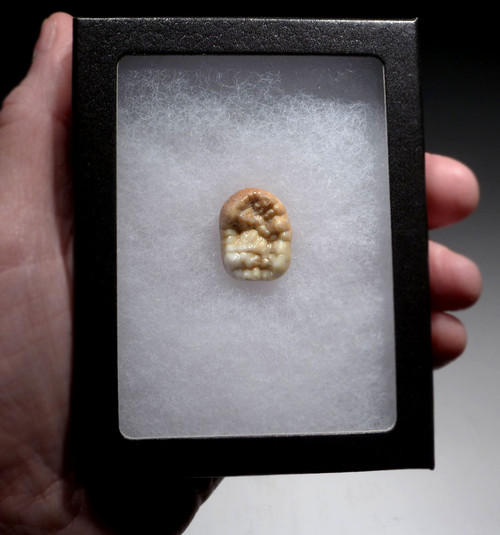
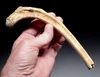
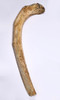
This fossil Cave Bear partial rib bone found in its original broken condition, comes from the extinct giant Cave Bear, Ursus spelaeus of Europe. It is rare as it was found in a cave located in the Ardennes Forest in Belgium. Found incomplete, evidence of its original state can be seen on the broken end that is impacted with cave floor sediment and identical color to the fracture surface of the bone. Fossil bones of the Cave Bear are much less commonly seen offered compared to teeth so this makes an interesting addition to an Ice Age display. This fossil Cave Bear bone would also make an interesting talisman.
Coming from the only private collection of Ardennes Forest cave fossils from Belgium we have ever known of, or will ever have since fossil collecting in this area is forbidden and has been for a number of years.
Many years ago, we acquired a collection of cave fossils found in the Ardennes Forest of Belgium. The collection was formed in the 1960's and comprised fossils of predators such as Cave Bear and Cave Hyena, but also fossils of their prey such as Wild Boar. Despite a large part of our business and years of experience being based in Europe, this collection was the single instance ever, we have encountered cave fossils from Belgium! The cave deposit was wet, making the fossil preservation more fragile than usual, requiring the original collector to apply consolidant glue to the fossils in the field, sometimes in a crude manner. The fossils are much whiter in color than those found in the Carpathian Mountains of Romania, adding to their uniqueness. An interesting observation of the fossil layers indicates the wild boar were killed mostly by the Cave Hyenas and their carcasses brought back to the hyena den in the cave. According to the collector who originally dug the fossils, the layer of boar fossils were BELOW the layer of the hyena fossils, confirming this predator-prey relationship. For advanced Ice Age collectors, these fossils are a once-in-a-lifetime opportunity.
HISTORY
The Cave bear (Ursus spelaeus) is a prehistoric species of bear that lived in Europe and Asia during the Pleistocene and became extinct about 20,000 years ago during the Last Glacial Maximum. The common and scientific name for the species comes from their remains having been found largely in caves.
The Cave bear's range stretched across Europe; from Spain and the British Isles in the west, Belgium, Italy, parts of Germany, Poland, the Czech Republic, the Balkans, Romania, Georgia, and parts of Russia, including the Caucasus; and northern Iran. No traces of Cave bears have been found in the northern British Isles, Scandinavia or the Baltic countries, which were all covered in extensive glaciers at the time. The largest numbers of Cave bear remains have been found in Austria, Switzerland, northern Italy, northern Spain, southern France, and Romania, roughly corresponding with the Pyrenees, Alps, and Carpathians.
Cave bear and Brown bear remains that are modified by Neanderthals to be used as tools have been found in various regions across Europe, indicating the exploitation of bear carcasses by Paleolithic humans. An unusual discovery in a deep chamber of Basura Cave in Savona, Italy, is thought to be related to Cave bear worship, because there is a vaguely zoomorphic stalagmite surrounded by clay pellets. It is thought to have been used by Neanderthals for a ceremony; bear bones scattered on the floor further suggests it was likely to have had some sort of ritual purpose.