 US DOLLAR
 EURO
EURO
 AUSTRALIAN DOLLAR
 CANADIAN DOLLAR
 POUND STERLING








Product Description
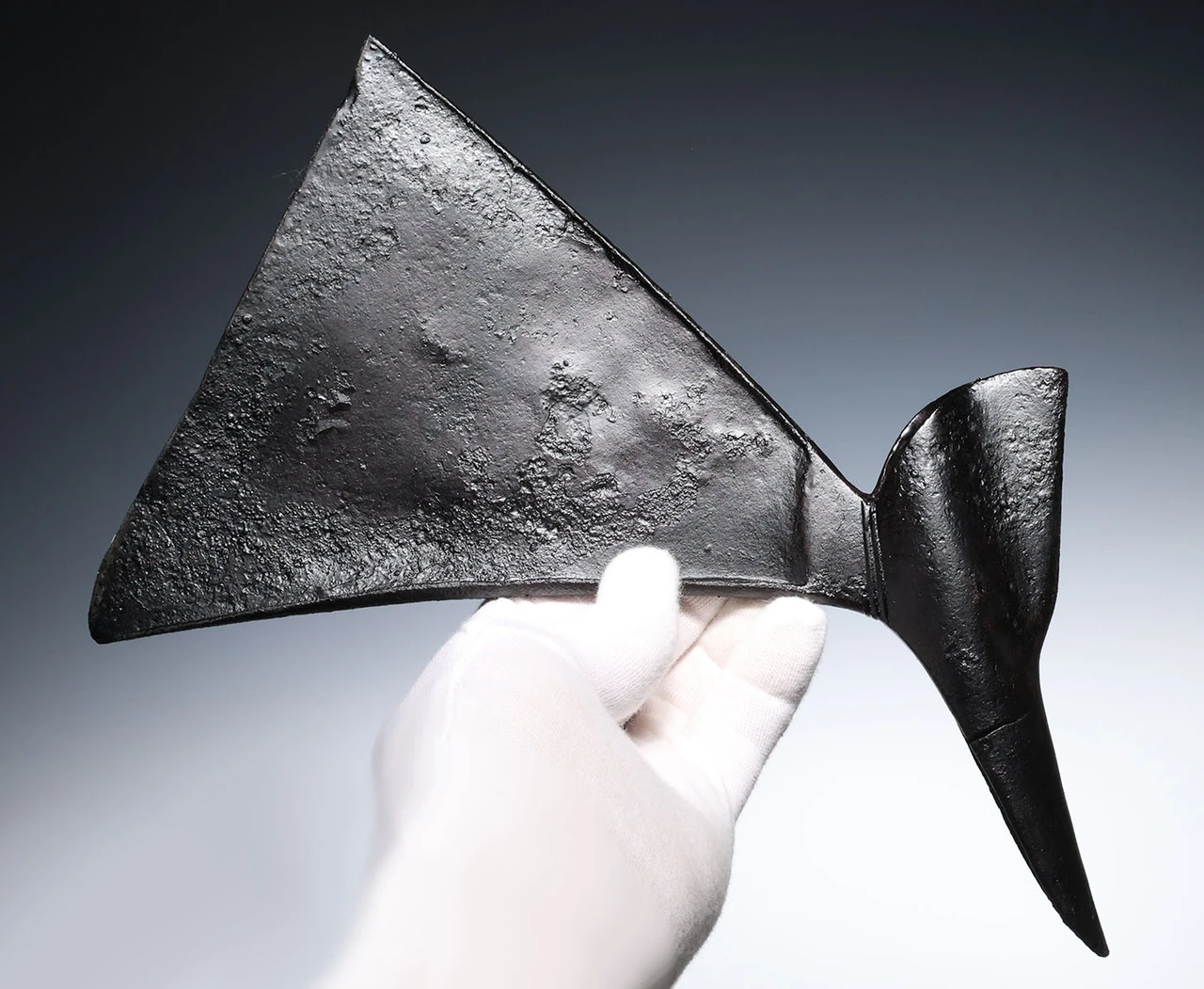
This is a rare, exceptionally large, and highly unusual steel battle axe from the Khond tribe of east central India. It dates from the 16th to the 18th century A.D., and has actually been used in combat as evidenced by the crack in the long shaft hub (see photos) from hard impact. The Khond tribe's origin is not certain as they had no written history but it is believed to be as early as 500 B.C. although could be possibly earlier. They were always feared as fierce warriors who ritually practiced human sacrifice. Their weapons are quite unusual and many are illustrated in the publication "Indian and Oriental Armour" by Lord Egerton of Tatton, London, 1896. In that book, this axe is seen on page 73, Fig 15, Cat. No. 51. He reports that the axe of the same type comes from the Chota Nagpur Plateau of India. Other specimens that share similarity to this axe are seen in other museum collections with attributions to the Khond people of Orissa.
While this specific type axe is very rare, an identical specimen can be seen in the Metropolitan Museum of Art in New York. It is collection Object Number: 36.25.1825 but is shown incorrectly mounted upside down. We know this is true as the damage to the hub of this axe could never have happened had the axe been mounted and used in the way the Met Museum displays it. Also, the specimen we are offering here is 50% larger than the Met Museum's item.
Mounted on a large shaft pole, this would have been an extremely intimidating and effecting pole arm weapon. The leading pointed edge would have had a very deadly penetrating ability, and because of the angle, the broad blade would have been angled correctly if the axe head was deployed on a long pole, making contact with the enemy from a slight distance back further than close combat. It is complete and intact with excellent metal preservation.
Unlike most metal artifacts sold on the market that are untreated and uncleaned, our specimens our properly cleaned, inspected and conserved in our museum conservation lab prior to being offered for sale to our clients.
HISTORY
Khonds (also known as Kondha and Kandha) are a Dravidian ethnic group and indigenous tribal community in India. Traditionally subsistence farmers, they are divided into the hill-dwelling Khonds and plain-dwelling Khonds for census purposes, but the Khonds themselves identify by their specific clans. Khonds usually hold large tracts of fertile land, but still practice hunting, gathering, and slash-and-burn agriculture in the forests as a symbol of their connection to, and as an assertion of their ownership of the forests wherein they dwell. Khonds speak the Kui language and write it in the Odia script. The Khonds are the largest tribal group in the state of Odisha. They are known for their rich cultural heritage, valorous martial traditions,and indigenous values, which center on harmony with nature.
The exact date when the Khond people first established their society is lost to antiquity, as they are an indigenous (Adivasi) tribal community with an ancient oral tradition rather than written historical records. However, historical and linguistic consensus suggests their society was established in eastern India by at least 500 BC, if not much earlier.
The Khonds became notorious, on the British occupation of their district about 1835, from the prevalence and cruelty of the human sacrifices they practiced. These Meriah sacrifices, as they were called, were intended to further the fertilization of the earth. It was incumbent on the Khonds to purchase their victims. Unless bought with a price they were not deemed acceptable. They seldom sacrificed Khonds, though in hard times Khonds were obliged to sell their children and they could then be purchased as Meriahs. Persons of any race, age or sex, were acceptable if purchased. Numbers were bought and kept and well treated; and Meriah women were encouraged to become mothers. Ten or twelve days before the sacrifice the victims hair was cut off, and the villagers having bathed, went with the priest to the sacred grove to forewarn the goddess. The festival lasted three days, and the wildest orgies were indulged in.
REFERENCES:
https://www.historyjournal.net/article/793/8-6-7-965.pdf
https://www.metmuseum.org/art/collection/search/30808