US DOLLAR
 EURO
EURO
 AUSTRALIAN DOLLAR
 CANADIAN DOLLAR
 POUND STERLING









Product Description
SEE MORE ANCIENT NEAR EASTERN ARTIFACTS
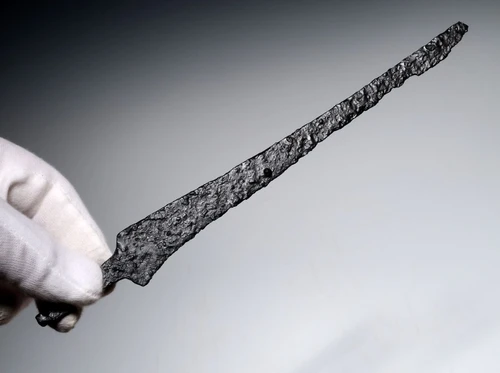
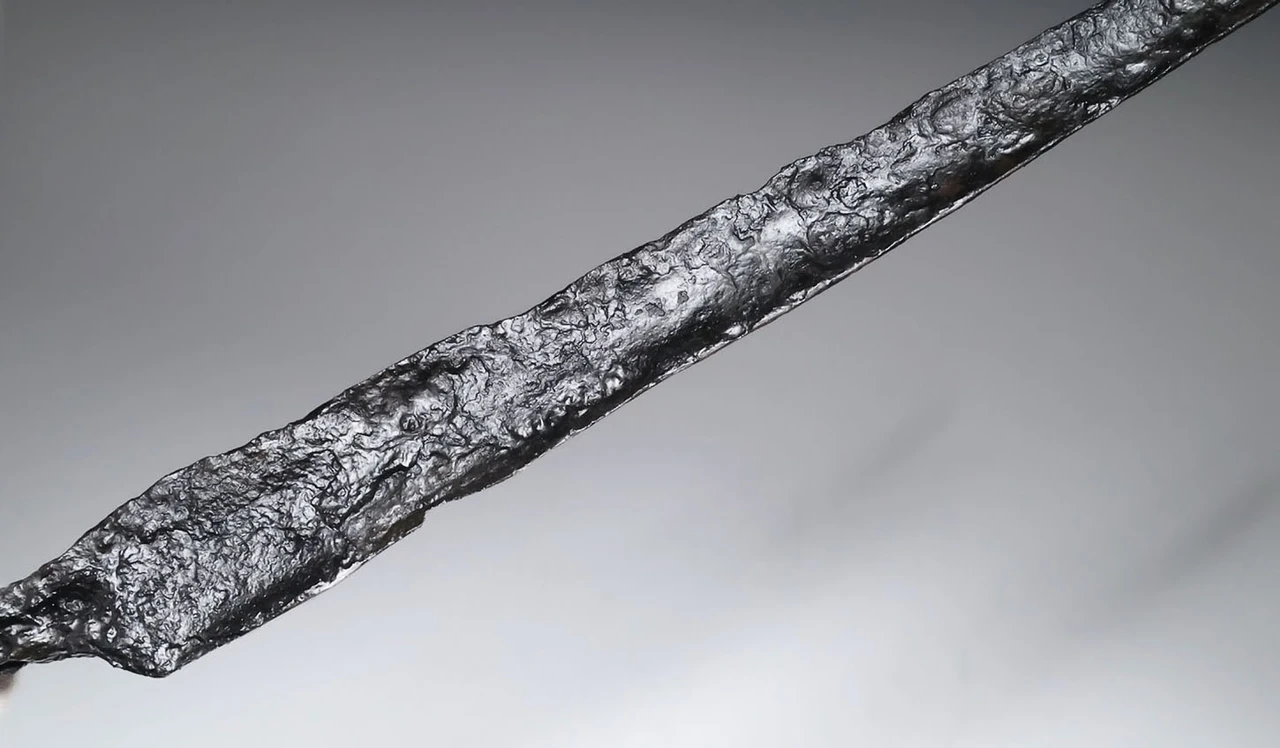
This ancient iron hybrid knife short sword is attributed to the early Ancient Persian Empire, dating from the 6th to 4th Century B.C.. It features a very unique one piece forged design - a cupped, long and thin tapered blade with a sharp tip, integral handle and ring pommel. These were special weapons, carried for close combat and meant for stabbing and thrusting attacks. The cupped or curved edge of the blade was meant to add strength and prevent bending during impact, as it compensated for the normally fragile nature of such a narrow blade. The reason for the thin narrow blade was so it could defeat enemy scale and leather armor, popular in the days of its existence. This was the precursor to later steel stabbing knife-short swords that would come out in the medieval period such as the Khyber knife and the Pesh-kabz.
Despite the delicate nature of this knife and the fact it is made of iron, it still possesses rare, excellent preservation and is intact with its full blade, integral handle and ring pommel. Professionally cleaned and conserved in our lab, being treated with a special sealer for ancient metal preservation.
HISTORY
The Achaemenid Empire (c. 550–330 BC), also called the First Persian Empire, was an empire based in Western Asia, founded by Cyrus the Great. At its greatest extent, it ranged from the Balkans and Eastern Europe in the west, to the Indus Valley in the east. It was larger than any previous empire in history, spanning 5.5 million square kilometers. Incorporating various peoples of different origins and faiths, it is notable for its successful model of a centralized, bureaucratic administration (through satraps under the King of Kings), for building infrastructure such as road systems and a postal system, the use of an official language across its territories, and the development of civil services and a large professional army. The empire's successes inspired similar systems in later empires.
By the 7th century BC, the Persians had settled in the southwestern portion of the Iranian Plateau in the region of Persis, which came to be their heartland. From this region, Cyrus the Great advanced to defeat the Medes, Lydia, and the Neo-Babylonian Empire, establishing the Achaemenid Empire.
Alexander the Great, an avid admirer of Cyrus the Great, conquered most of the empire by 330 BC. Upon Alexander's death, most of the empire's former territory came under the rule of the Ptolemaic Kingdom and Seleucid Empire, in addition to other minor territories which gained independence at that time. The Iranian elites of the central plateau reclaimed power by the second century BC under the Parthian Empire.
The Achaemenid Empire is noted in Western history as the antagonist of the Greek city-states during the Greco-Persian Wars. The empire was instrumental in the spread of Zoroastrianism as far east as China. The empire also set the tone for the politics, heritage and history of modern Iran.
The Persian cavalry was crucial for conquering nations, and maintained its importance in the Achaemenid army to the last days of the Achaemenid Empire. The cavalry were separated into four groups. The chariot archers, horse cavalry, the camel cavalry, and the war elephants.
In the later years of the Achaemenid Empire, the chariot archer had become merely a ceremonial part of the Persian army, yet in the early years of the Empire, their use was widespread. The chariot archers were armed with spears, bows, arrows, swords, and scale armour. The horses were also suited with scale armour similar to scale armour of the Sassanian cataphracts. The chariots would contain imperial symbols and decorations. The horses used by the Achaemenids for cavalry were often suited with scale armour, like most cavalry units. The riders often had the same armour as infantry units, wicker shields, short spears, swords or large daggers, bow and arrow and scale armour coats. The camel cavalry was different, because the camels and sometimes the riders, were provided little protection against enemies, yet when they were offered protection, they would have spears, swords, bow, arrow, and scale armour. The camel cavalry was first introduced into the Persian army by Cyrus the Great, at the Battle of Thymbra. The elephant was most likely introduced into the Persian army by Darius I after his conquest of the Indus Valley. They may have been used in Greek campaigns by Darius and Xerxes I, but Greek accounts only mention 15 of them being used at the Battle of Gaugamela.