 US DOLLAR
 EURO
 AUSTRALIAN DOLLAR
 CANADIAN DOLLAR
 POUND STERLING

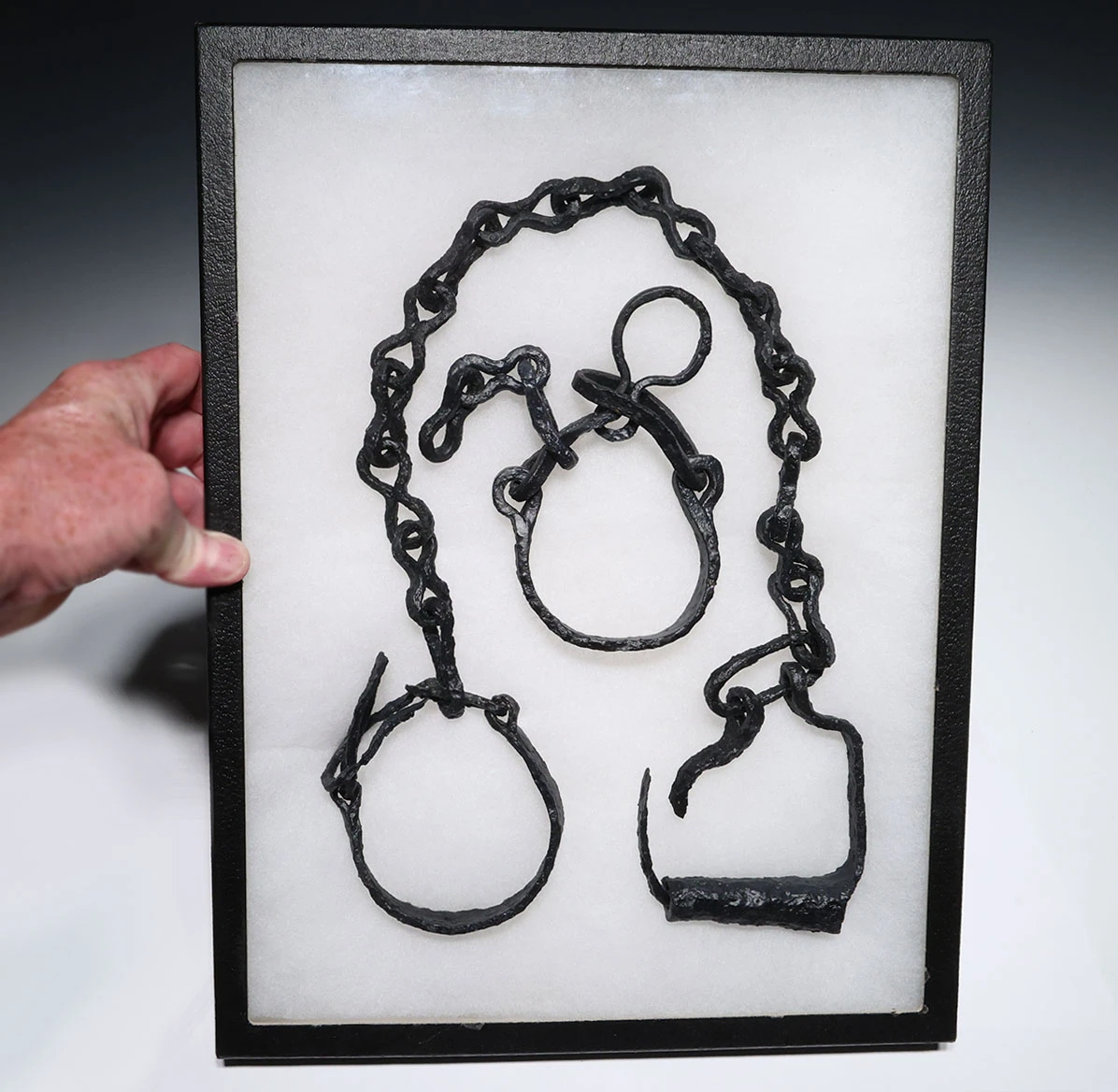

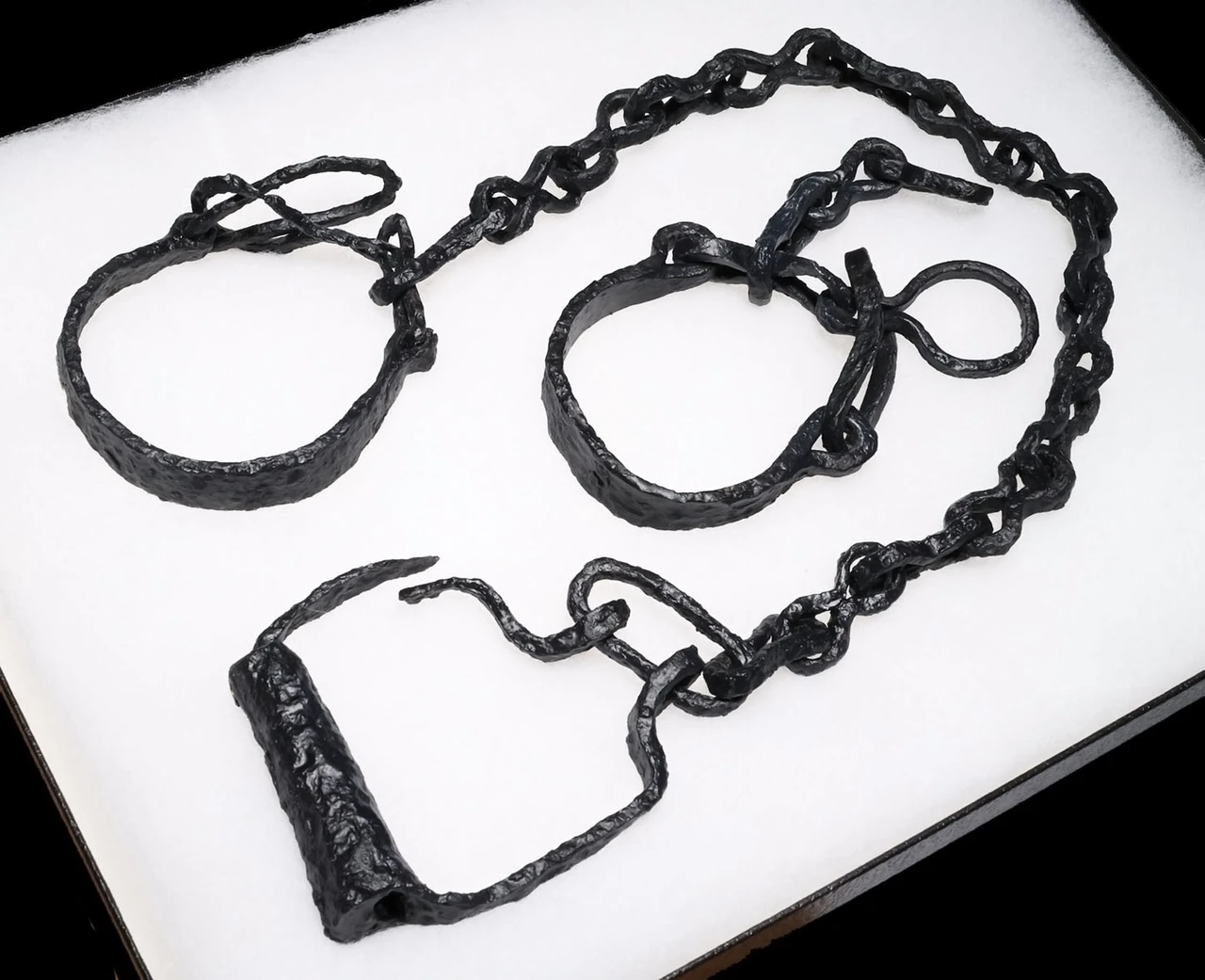











Product Description
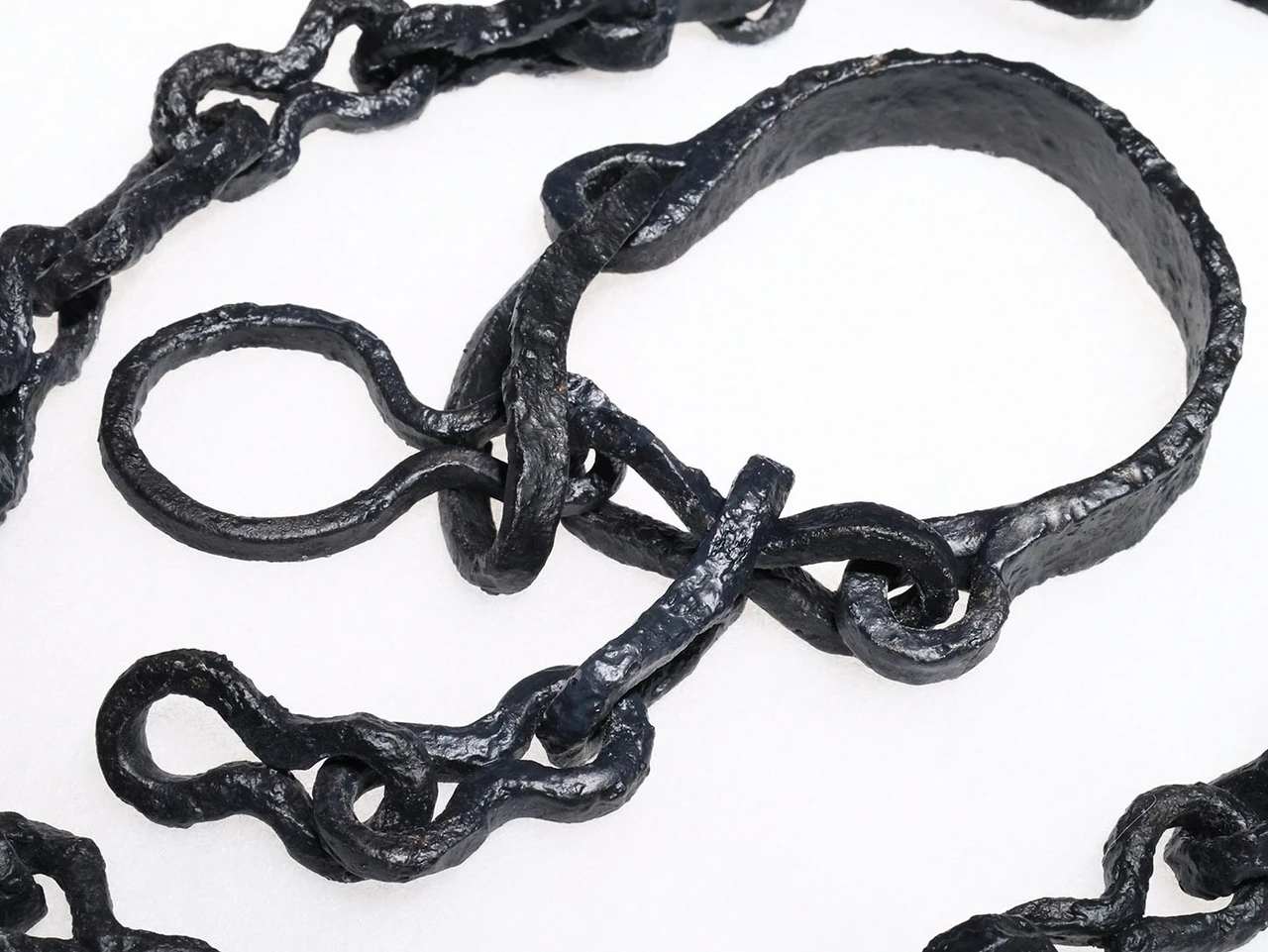
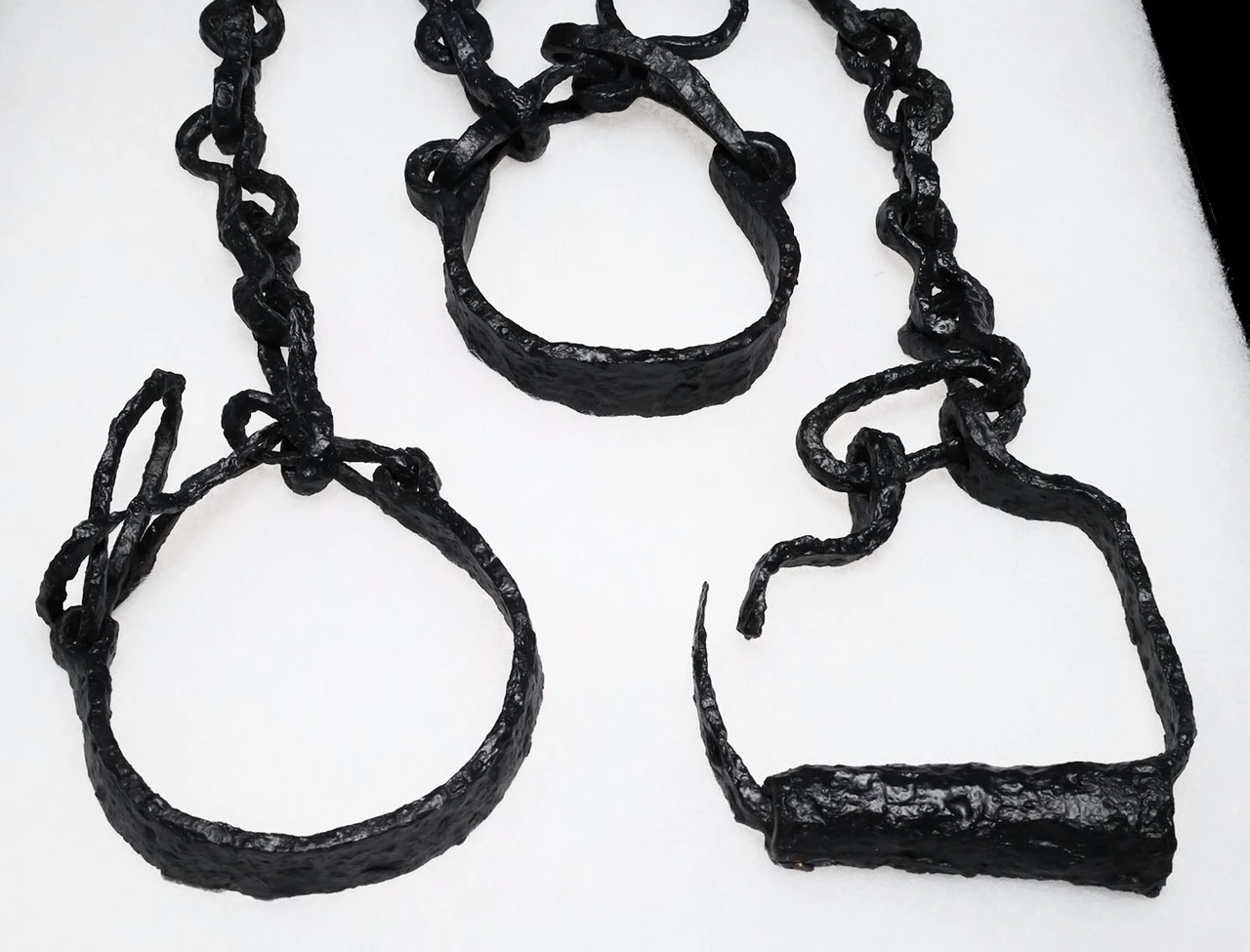
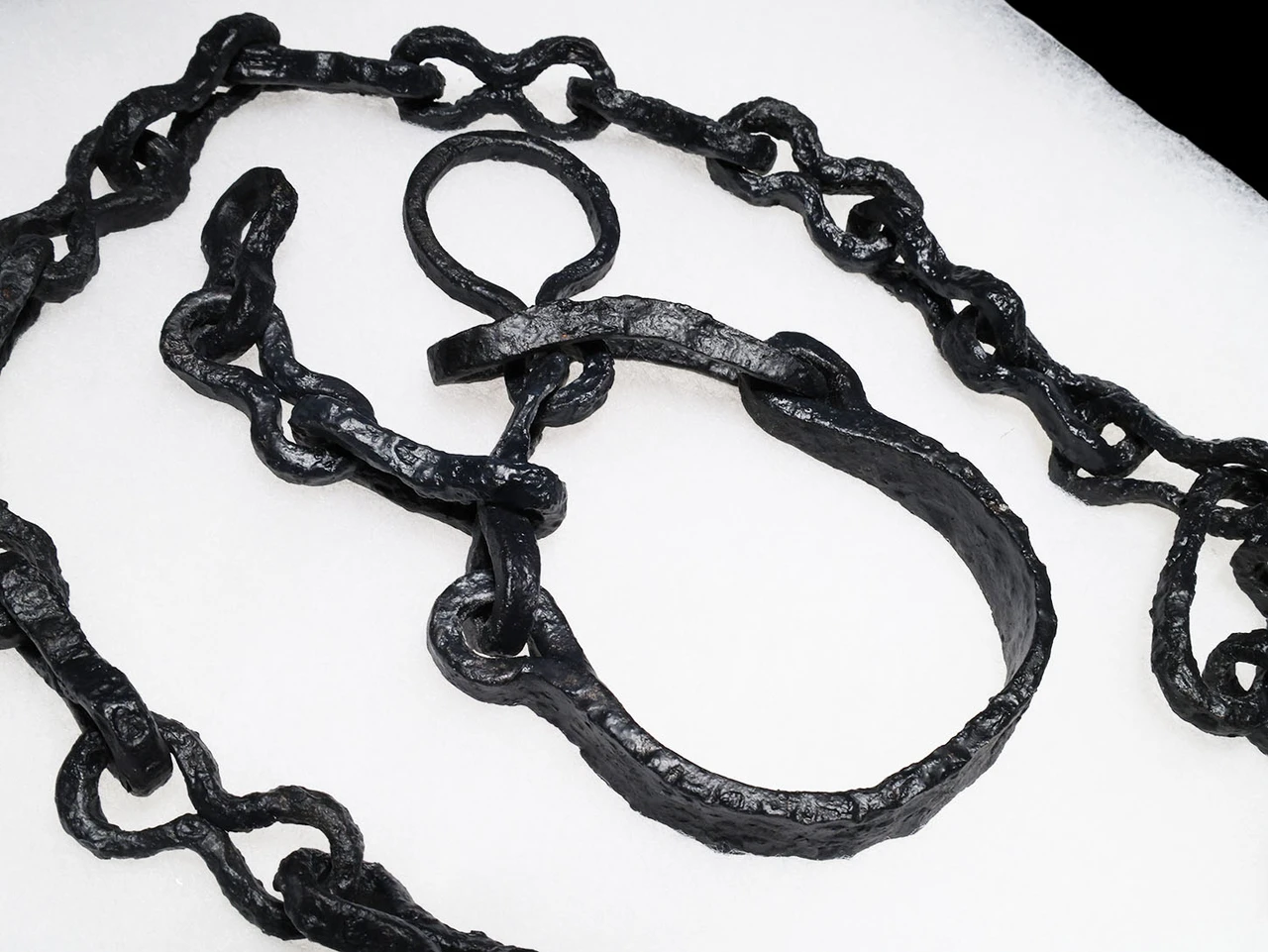
This RARE set of slave iron restraint chains and shackles comes from the Mongol Empire of Central Asia, and dates from the 13th to 14th century A.D.. The Mongol Empire of the 13th and 14th centuries was the largest contiguous land empire in history and it established a massive international slave trade founded upon war captives enslaved during the Mongol conquests. This is a completely original set of hand-forged iron restraints as originally found - and first and only instance we have ever had such an item in our entire 35 year career history of handling ancient objects.
Acquired from an old multi-generational Middle East collection, when we received this specimen, it was completely encrusted with the rust welding the chains immovable. We completely cleaned and fully conserved the metal in our on-site preparation lab and preserved the original surface so that it is now stable and safe to handle. This is a once-in-a-lifetime acquisition that demonstrates the massive growth and expansion of what fueled the Mongol Empire, founded by Genghis Khan - the slave trade.
HISTORY
The Mongol Empire of the 13th and 14th centuries was the largest contiguous land empire in history. Originating in present-day Mongolia in East Asia, the Mongol Empire at its height stretched from the Sea of Japan to parts of Eastern Europe, extending northward into parts of the Arctic; eastward and southward into parts of the Indian subcontinent, attempted invasions of Southeast Asia, and conquered the Iranian Plateau; and westward as far as the Levant and the Carpathian Mountains.
The Mongol Empire emerged from the unification of several nomadic tribes in the Mongol homeland under the leadership of Temüjin, known by the more famous title of Genghis Khan (c. 1162–1227), whom a council proclaimed as the ruler of all Mongols in 1206. The empire grew rapidly under his rule and that of his descendants, who sent out invading armies in every direction. The vast transcontinental empire connected the East with the West, and the Pacific to the Mediterranean, in an enforced Pax Mongolica, allowing the exchange of trade, technologies, commodities, and ideologies across Eurasia.
From the 1220s into the 1240s, the Mongols conquered the Turkic states of Volga Bulgaria, Cumania and Iranian state of Alania, and various principalities in Eastern Europe. Following this, they began their invasion into Central Europe by launching a two-pronged invasion of then-fragmented Poland. Invasions also were launched into the Caucasus against the Kingdom of Georgia and the Chechens and Ingush, as well as into the Southeast Europe against Bulgaria, Croatia, and the Latin Empire. Their conquests integrated much of Eastern European territory into the empire of the Golden Horde. Warring European princes realized they had to cooperate in the face of a Mongol invasion, so local wars and conflicts were suspended in parts of central Europe, only to be resumed after the Mongols had withdrawn. After the initial invasions, subsequent raids and punitive expeditions continued into the late 13th century.
The Mongols were most famous for their horse archers, but troops armed with lances were equally skilled, and the Mongols recruited other military specialists from the lands they conquered. Forces under the command of the Mongol Empire were trained, organized, and equipped for mobility and speed. Mongol soldiers were more lightly armored than many of the armies they faced but were able to make up for it with maneuverability. Each Mongol warrior would usually travel with multiple horses, allowing him to quickly switch to a fresh mount as needed. In addition, soldiers of the Mongol army functioned independently of supply lines, considerably speeding up army movement. Skillful use of couriers enabled the leaders of these armies to maintain contact with each other.
In pre-imperial Mongolia, slavery had not played any big part, but the Mongol invasions and conquests of the 13th century created a great influx of war captives, which were by custom considered legitimate to enslave, and caused a significant expansion of slavery and slave trade. The Mongol Empire established a massive international slave trade founded upon war captives enslaved during the Mongol conquests, which were distributed by market demand around the empire via a network of slave markets connected through the cities of the empire.
One of the most important markets for the Mongol Empire were the Muslim Delhi Sultanate in northern India. The Delhi Sultanate had an import of slaves from the Central Asian slave market already before the Mongol Empire, and this trade was not interrupted when the Mongols took the Central Asian Bukhara slave market, which was merely incorporated in to the empire's slave trade network. The Delhi Sultanate was dependent on a constant supply of male Turkish slaves from Central Asia as slave soldiers, and these were regularly provided to India via the Hindu Kush from Central Asia.
The Muslim world of the Middle East was the biggest market for the slave trade of the Empire. There were traditionally an established market in the Muslim world for slave girls for sexual slavery as concubines, and for slave-boys for military slavery as slave soldiers.
Bukhara in Central Asia was since ancient times a provider of slaves to the Muslim Middle East, and used by the Empire to traffic slaves suitable for the Muslim slave market; from Central Asia, the slave trade route continued via Tabriz to Aleppo.
Male slaves for military slavery (Ghilman) were trafficked from China to the Middle East via Central Asia and Iran. When the Kipchak Turks were subjugated by the Mongols after the 1237-1241 campaign, many of the Kipchak people were exported by the Mongols to slavery in Egypt. Turkish slave soldiers were transported from the Golden Horde in Central Asia to the Mamluk Sultanate in Egypt via the Black Sea. The Mongol Empire also traded Christian slaves. After the Siege of Acre, the inhabitants of the city, being Frankish Christians, were deported to the slave market of Baghdad.