US DOLLAR
 EURO
 AUSTRALIAN DOLLAR
 CANADIAN DOLLAR
 POUND STERLING



Product Description
SEE MORE ANCIENT NEAR EASTERN ARTIFACTS
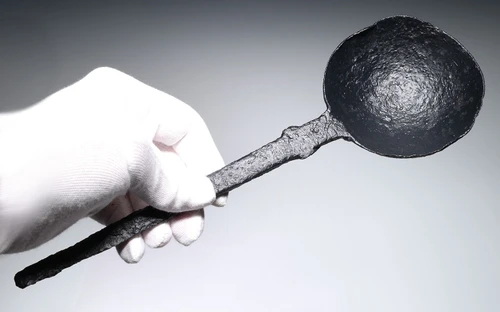
For the first time we have seen such an object available for private sale, this ancient iron handled rasp file comes from the ancient Ghaznavid Empire. The Ghaznavids were a Turkish slave-soldier dynasty (mamluk or ghulam) who ruled a sultanate that rose to dominance in eastern Iran, central Afghanistan, and modern-day Pakistan. The Ghaznavid Empire was a culturally Persianate Sunni Muslim state of Turkic Karluk origin. Flourishing from 977 to 1186 AD, the empire spread from the Oxus to the Indus Valley at its greatest extent. The Ghaznavid Empire was a unique and important part of world history where Eastern and Western influences converged. The dynasty represented an unusual melding of early Arabic Islam and nomadic culture. Very little of this empire has survived today and despite being once an enormous militaristic dominating force, rarely are ANY artifacts from the culture seen available for acquisition.
This handled rasp file is made of iron and shows hand-punched teeth on the flat faces wish linear file cuts on the edges. You can see the irregularity of each punched tooth in the rasp body. After the teeth would have been punched, the rasp would have been tempered to harden it by heating and then quenching in oil and water. The original iron handle is still in place and you can see a decorative copper band decoration going around the edge in places. Making such a tool in ancient times, was a lengthy undertaking and it would have only been owned by a specialized master working in the handcraft arts. A tool like this would have been used to shape wood, bone, ivory or antler. For most of our three decade career, our focus of ancient objects has primarily been weapons but despite that, we have never seen ancient tools of trades like this. There are several scientific publications that have documented specimens in museum and institutional collections but one like this, in private hands is beyond rare. This is a single offering we are making with no other similar objects ever again available to offer. Professionally cleaned and conserved in our museum lab facility to ensure against further deterioration.
Unlike most metal artifacts sold on the market that are untreated and uncleaned, ALL our metal artifacts are properly cleaned, inspected and conserved in our museum conservation lab prior to being offered for sale to our clients. The vast majority of sellers of metal artifacts do NOT PROPERLY clean and treat their specimens and many do nothing at all. Metal artifacts NOT treated and stabilized correctly WILL CONTINUE TO CORRODE AND EVENTUALLY DISINTEGRATE.
HISTORY
The Ghaznavid Empire was named after the city of Ghazni in modern Afghanistan where its founder was freed from slavery and led a subsequent revolt, freeing a great number of people from the former Samanid Dynasty. It emerged from Turkic mamluk soldier slaves of the Samanids and included a unique blend of eastern and western influences. The Ghaznavids flourished in power from 977 - 1186 A.D.. In its height, the Ghaznavid Empire included all of Persia, Transoxania and Northern India.
The Ghaznavid Empire is most notably associated with Mahmud, the son of its founder Sebuktigin. As a devout Muslim, Mahmud reshaped the Ghaznavids from their pagan Turkic origins into an Islamic dynasty and expanded the frontiers of Islam. With fierce military power and tactics, he created an empire that stretched from the Oxus to the Indus Valley and the Indian Ocean. Amongst many achievements, he is attributed with the development of the Urdu language which is a mixture of Farsi, Turkish, Arabic and Sanskrit. Urdu became the language for India and Pakistan in Arabic script.
In the Indian subcontinent, Mahmud is most famously (or infamously) known for supplanting Hinduism with Islam by devastating military campaigns. Indian invasions of Mahmud were specifically directed to temple towns as Indian temples were depositories of great wealth and the economic and ideological centers of gravity for the Hindus. The Ghaznavids brought Islam to India by "fire and sword" as Mahmud once put it, and returned with fabulous riches taken from both Indian princes and temples. During this time visitors to and residents of Ghazni wrote with wonder of the ornate architecture of its buildings, the great libraries, the sumptuousness of the court ceremonies and of the wealth of precious objects owned by Ghazni's citizens. The seemingly never-ending victories of Mahmud the Ghazni brought incredible wealth and opulence into his power and he transformed the city of Ghazni into a jewel in the crown of the Islamic Caliphate of the 11th century A.D.. By 1040 A.D., a turning point for the worse came with a horrible defeat of the Ghaznavids by the Seljuk Turks which removed all the Iranian and Central Asian region from Ghazni power. By 1130 A.D., another crushing defeat took away the control of all the Indian territories and the Ghaznavid Empire did all it could to survive until its total eradication in 1186 A.D..
The Ghaznavid military was a formidable power. Its elite palace guard comprised 4,000-6,000 heavy cavalry. The remaining force brought the total army count to around 30,000 strong. The Ghaznavid cavalry was armed with recurve bows, maces, battleaxes, long curved swords, and even lances but this varied by soldier depending on their ethnic origin. Maces were particularly considered a weapon of military prowess and heroism. Their horses were either lightly or not armored at all.
Regular infantry wore chain mail coats and carried metal shields covered in leather. They were equipped with long recurve bows and spears and for close hand-to-hand combat, they carried a mace or short sword on a belt. The regular foot auxiliary soldiers sometimes fought on camels, horses or mules but often would dismount and fight on ground once fully deployed. Subordinated Hindu princes were required to pay tribute in elephants and large annual counts were held where as many as 1670 "battle-ready" elephants were documented. A standing force of 1000 elephants was kept at Ghazni. Historians have recorded forces of 400-700 elephants in individual battles, with each elephant bearing a crew of four spearmen or archers. The Ghaznavid baggage trains also employed elephants. Their war elephants were fearsome military weapons, heavily armored with castle-like structures on their backs housing the soldiers and with heavy plate armor protecting their bodies. Their tusks were even equipped with poison covered giant blades. War elephants were often used as individual mobile independent forces with a supporting mini-army and cavalry of warriors. Riskier but more effective tactics employed the elephants in solid battle lines where they charged into the center of an enemy force and literally crushed and destroyed paths of all that got in their way.