US DOLLAR
 EURO
EURO
 AUSTRALIAN DOLLAR
 CANADIAN DOLLAR
 POUND STERLING


Product Description
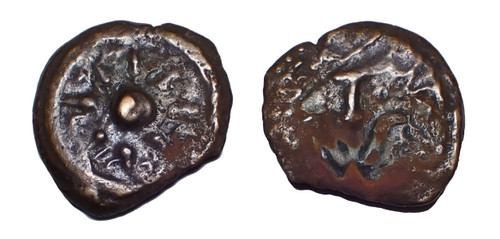
This genuine Judean bronze prutah ancient coin was minted by Alexander Jannaeus in 104 - 76 BC, in the Judean Kingdom. The obverse displays a star with eight rays. The reverse shows an upside down anchor with "Yehonatan, the king". In Paleo-Hebrew between the rays.
Anchor. “BAΣIΛEΩΣ AΛEΞANΔPOY” = “of King Alexander”.
Hendin (6th) 6189. Cleaned. Ex-Northern California, USA Collection.
One of the most popular ancient Biblical coins has its roots in New Testament history. It is the wonderful story that surrounds the "widow's mite" coin. The widow's mite was the lowest denomination coin circulating during the time of Christ, the small bronze prutahs issued by Alexander Jannaeus, King of Judea. These coins feature various designs including anchors, stars, cornucopias, lily flowers and a palm branch.
In describing an incident that involved Jesus, the disciple Mark wrote, "He sat down opposite the treasury and watched the people putting money into the treasury, and many of the rich put in a great amount. A poor widow came and put in two small coins, the equivalent of a penny. Then he called his disciples and said to them, 'In truth I tell you, this poor widow has put more in than all who have contributed to the treasury for they have put in money then could spare but she, in her poverty, has put in everything she possessed, all she had to live on.'"
HISTORY
The prutah was an ancient copper coin of the Second Temple period of Israel with low value. A loaf of bread in ancient times was worth about 10 prutot (plural of prutah). One prutah was also worth two lepta (singular lepton), which was the smallest denomination minted by the kings of the Hasmonean and Herodian dynasties.
Prutot were also minted by the procurators of Roman Judaea, and later were minted by the Jews during the First Jewish–Roman War (sometimes called "Masada coins").