 US DOLLAR
 EURO
EURO
 AUSTRALIAN DOLLAR
 CANADIAN DOLLAR
 POUND STERLING





Product Description
SEE MORE AFRICAN NEOLITHIC ARROWHEADS
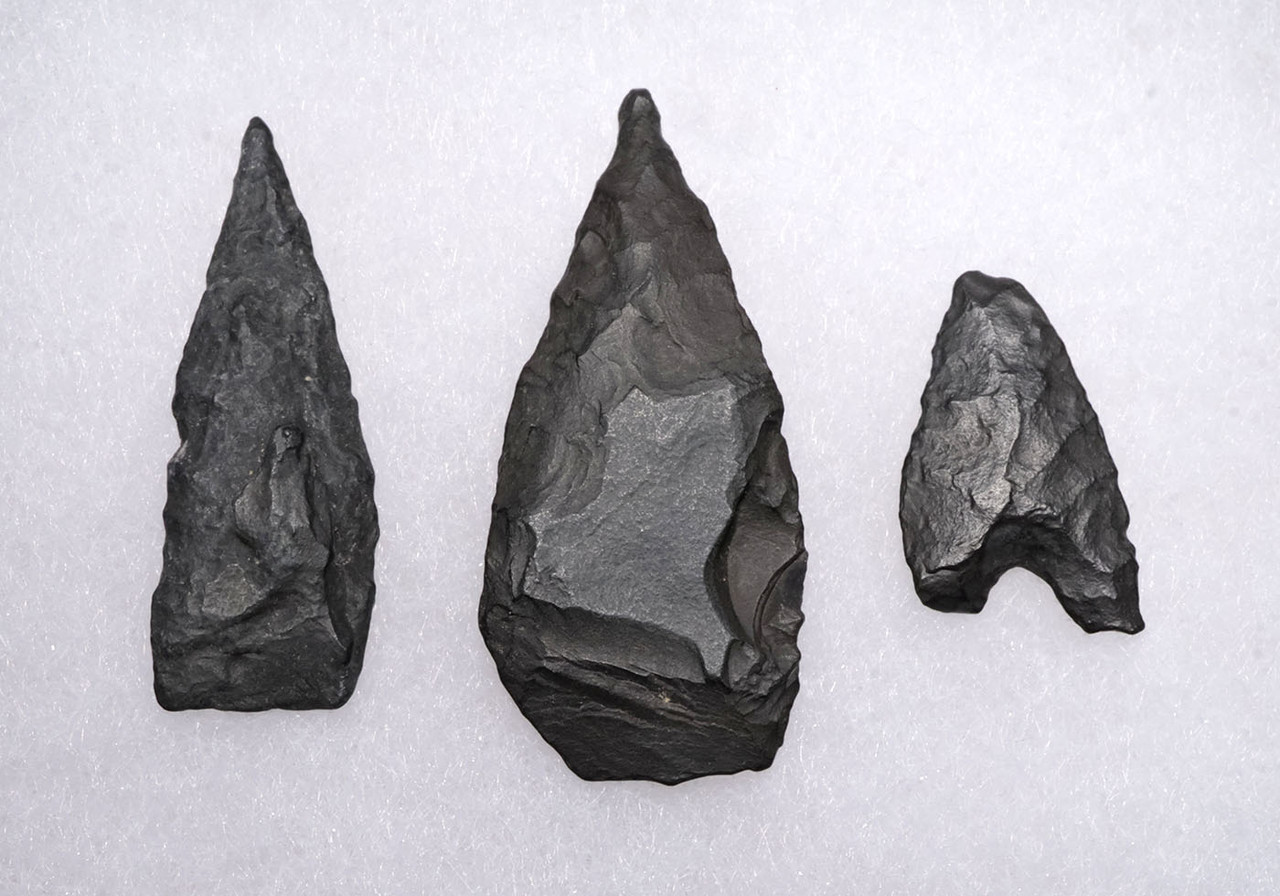
This premium set includes three complete indurated shale Capsian projectile point Epipaleolithic period arrowheads. They were found on an exposed Capsian tool site in the Sahara Desert in Northwest Africa. Each was masterfully fashioned by modern Homo sapiens, between 8000 B.C. and 5400 B.C. These are exceptional and complete, hand-picked examples from large quantities of the more common damaged and incomplete specimens. They display rare, delicate and unbroken features, as well as exceptional symmetry. Very seldom do arrowheads of this type, survive undamaged as these have. Not to be confused with Neolithic of Capsian Tradition, these arrowhead pre-date the later more refined Neolithic types that would come thousands of years later in the Neolithic.
We have been obsessively collecting the finest prehistoric African objects for the past 25+ years and this specimen set comes from a small, select group we have been holding onto for the duration of more than two decades. We have been to the source in the Sahara and scoured literal buckets and barrels of tens of thousands of arrowheads each year, for many years. Over the past decades, we have also purchased large private collections in America and Europe. In all this time, we would set aside the RAREST OF THE RAREST arrowheads of all prehistoric cultures, and it is now time for us to sell some from this private, ultra-rare stash. The collection is small and limited. Each piece represents the highest degree of workmanship that we have ever seen. The sites where arrowheads like this were once found, have been entirely picked clean for years. In over the last two decades, poor safety and security in the desert, as well as newly established and enforced laws in North Africa, prevent any new collecting or discoveries to be made, making these artifacts increasingly desirable and valuable.
If you strive to build a super-select collection of only the finest, rare specimens rather than boxes and boxes of ordinary types that will never appreciate or impress, then this offering is for you!
HISTORY
The Capsian was an Epipalaeolithic tradition in North Africa from ca. 9000 to 5400 cal BC. It is named after the town of Gafsa, Tunisia (Capsa in Latin). Like its predecessor, the Ibero-Maurusian industry (or Oranian industry), the Capsian was a microlithic (tiny-flaked-blade) tool complex. It differed from the Ibero-Maurusian, however, in displaying a far more varied tool kit.
The Capsian is traditionally divided into the typical Capsian and the Upper Capsian, which are sometimes found in chrono-stratigraphic sequence. In terms of lithics, the differences between these divisions are both typological and technological. Anatomically, Capsian populations were modern Homo sapiens, traditionally classed into two variegate types: Proto-Mediterranean and Mechta-Afalou on the basis of cranial morphology and anthropological traits.
During this period, the environment of the Maghreb was open savanna (similar to modern East Africa) with Mediterranean forests at higher altitudes, where the initial phase overlaps with the African humid period. The Capsian diet included a wide variety of animals, ranging from aurochs and hartebeest to hares and snails, with little evidence of the diet including plants. During the succeeding Neolithic of Capsian Tradition, there is evidence from one site, for domesticated, probably imported, ovicaprids.
Decorative art can be found at Capsian sites, including figurative and abstract rock art. Ochre is found on both tools and corpses. Ostrich eggshells were used to make beads and containers; seashells were used for necklaces.


