US DOLLAR
 EURO
EURO
 AUSTRALIAN DOLLAR
 CANADIAN DOLLAR
 POUND STERLING



Product Description
SEE MORE ANCIENT NEAR EASTERN ARTIFACTS
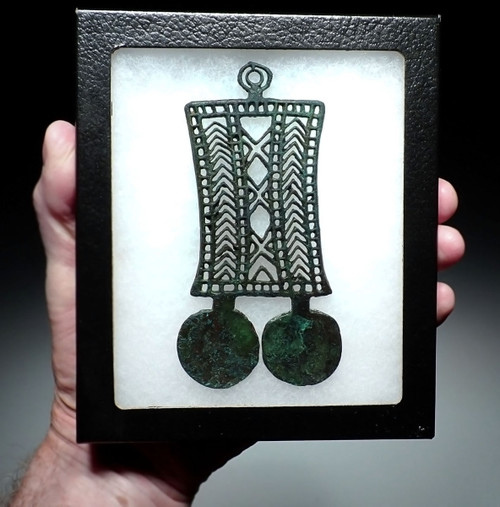
This is a genuine ancient bronze horse harness decorative strap fitting from the Saka Scythian nomadic horseback warriors of the Eurasian Steppe. Made by the lost wax casting method, it has a recessed floral design on the solid bronze outward display face, and an intact back side that would have gathered two leather horse harness straps at intersecting points through the back buckle structure. Objects like this from the ancient Eastern Scythian tribes are rarely seen outside of museum collections, making this a unique opportunity for advanced collectors to acquire a rare Scythian equestrian artifact. Intact ancient encrustations provide proof of age and an unaltered condition of its EXCEPTIONAL preservation. Safe to wear as a unique modern jewelry piece or incorporate into a modern jewelry design! Perfect for lovers of history and the equestrian art of the ancient world!
This artifact has been professionally cleaned and conserved in our lab, being treated with a special sealer developed and formulated by us specifically for ancient metal preservation. The patina shows beautiful traits only found in authentic ancient weapons. There is no active bronze disease. Bronze disease forms a corrosive powder that will literally eat away an artifact over time and destroy it.
HISTORY
The Scythians, also known as the Pontic Scythians, were an ancient Eastern Iranic equestrian nomadic people who migrated during the 9th to 8th centuries BC from Central Asia to the Pontic Steppe in modern-day Ukraine and Southern Russia, where they remained until the 3rd century BC.
Skilled in mounted warfare, the Scythians displaced the Agathyrsi and the Cimmerians as the dominant power on the western Eurasian Steppe in the 8th century BC. In the 7th century BC, the Scythians crossed the Caucasus Mountains and often raided West Asia along with the Cimmerians.
In the 6th century BC, they were expelled from West Asia by the Medes, and retreated back into the Pontic Steppe, and were later conquered by the Sarmatians in the 3rd to 2nd centuries BC. By the 3rd century AD, last remnants of the Scythians were overwhelmed by the Goths, and by the early Middle Ages, the Scythians were assimilated and absorbed by the various successive populations who had moved into the Pontic Steppe.
After the Scythians' disappearance, authors of the ancient, medieval, and early modern periods used their name to refer to various populations of the steppes unrelated to them.
While the ancient Persians used the name Saka to designate all the steppe nomads and specifically referred to the Pontic Scythians as Sakā tayaiy paradraya, lit. 'the Saka who dwell beyond the (Black) Sea'),[35] the name "Saka" is used in modern scholarship to designate the Iranic pastoralist nomads who lived in the steppes of Central Asia and East Turkestan in the 1st millennium BC.
Like the nomads of the Chernogorovka-Novocherkassk complex, the Scythians originated, along with the Early Sakas, in Central Asia and Siberia in the steppes corresponding to either present-day eastern Kazakhstan or the Altai-Sayan region. The Scythians were already acquainted with quality goldsmithing and sophisticated bronze-casting at this time, as attested by gold pieces found in the 8th century BC Aržan-1 kurgan.
The second wave of migration of Iranic nomads corresponded to the early Scythians' arrival from Central Asia into the Caucasian Steppe, which begun in the 9th century BC, when a significant movement of the nomadic peoples of the Eurasian Steppe started after the early Scythians were expelled from Central Asia by either the Massagetae, who were a powerful nomadic Iranic tribe from Central Asia closely related to them, or by another Central Asian people called the Issedones, forcing the early Scythians to the west, across the Araxes river and into the Caspian and Ciscaucasian Steppes.
This western migration of the early Scythians lasted through the middle 8th century BC, and archaeologically corresponded to the westward movement of a population originating from Tuva in southern Siberia in the late 9th century BC, and arriving in the 8th to 7th centuries BC into Europe, especially into Ciscaucasia, which it reached some time between c. 750 and c. 700 BC, thus following the same migration path as the first wave of Iranic nomads of the Chernogorovka-Novocherkassk complex.
REFERENCES
https://www.researchgate.net/publication/372420519_Goshko_Videiko_RA_XVIII_1_2022
https://www.researchgate.net/publication/273292865_The_Emergence_of_the_Tagar_Culture
https://www.researchgate.net/publication/309004423_New_Evidence_on_the_Early_Saka_Horse_Harness_from_Eastern_Kazakhstan