 US DOLLAR
 EURO
EURO
 AUSTRALIAN DOLLAR
 CANADIAN DOLLAR
 POUND STERLING


Product Description
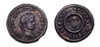
This genuine Roman bronze AE3 ancient coin was minted by Constantine II, the son of Constantine I (Constantine the Great). It was minted in Rome between 317 - 337 AD. The obverse shows a laureate bust of Constantine II facing right. The reverse shows a wreath with a votive inscription. RIC 163. Brown patina. Extra Fine.
HISTORY
The political history of the third and fourth centuries is very complex, with sometimes as many as five or more emperors in power at the same time. In 324 A. D., following the victory of Constantine over Licinius, the Roman Empire united under a single ruler for the first time since the sole rule of Diocletian from 285-286 A.D.. But, the victory that had the most historical impact was Constantine's defeat of Maxentius at the Milvian Bridge. This victory proved to be a major turning point for not only the Roman Empire, but for all Western civilization to come. In the final moments before going to battle, Constantine, greatly outnumbered by the enemy, saw a vision in the sky with Christian symbolism. From this vision, he believed he was directed by God to carry the sign of Christ into battle on their shields and banners. He converted after his miraculous victory and mandated Christianity as the new state religion thereby outlawing all other pagan beliefs. At the same time, work started on transforming the city of Byzantium into Constantine’s new Christian capitol of the empire. Constantinus Maximus (Constantine the Great) as he became known, had a large family, many of whom appear on coins. He fell ill and died near Nicomedia in 337 A.D., already a legend.
Constantine II was Roman emperor from 337 to 340. The son of the emperor Constantine I, he was proclaimed Caesar by his father shortly after his birth. He was associated with military victories over the Sarmatians, Alamanni and Goths during his career, for which he was granted a number of victory titles. Constantine I had arranged for his sons to share power with their cousins Dalmatius and Hannibalianus, but this was not accepted by Constantine II and his brothers. As a result, Constantine II's brother Constantius II ordered the killings of numerous male relatives following Constantine I's death, including Dalmatius and Hannibalianus, thus eliminating any possible opponents to the succession of Constantine I's sons. Constantine II then ascended to the throne alongside his two younger brothers, ruling Gaul, Hispania, and Britain.
Little is known about the names of denominations during this period due to extensive changes in Constantinian coinage. Modern numismatists, therefore, classify the bronze issue coins into four groups based on size known as AE1, AE2, AE3 and AE4