 US DOLLAR
 EURO
EURO
 AUSTRALIAN DOLLAR
 CANADIAN DOLLAR
 POUND STERLING







Product Description
SEE MORE MESOLITHIC FLAKE TOOLS
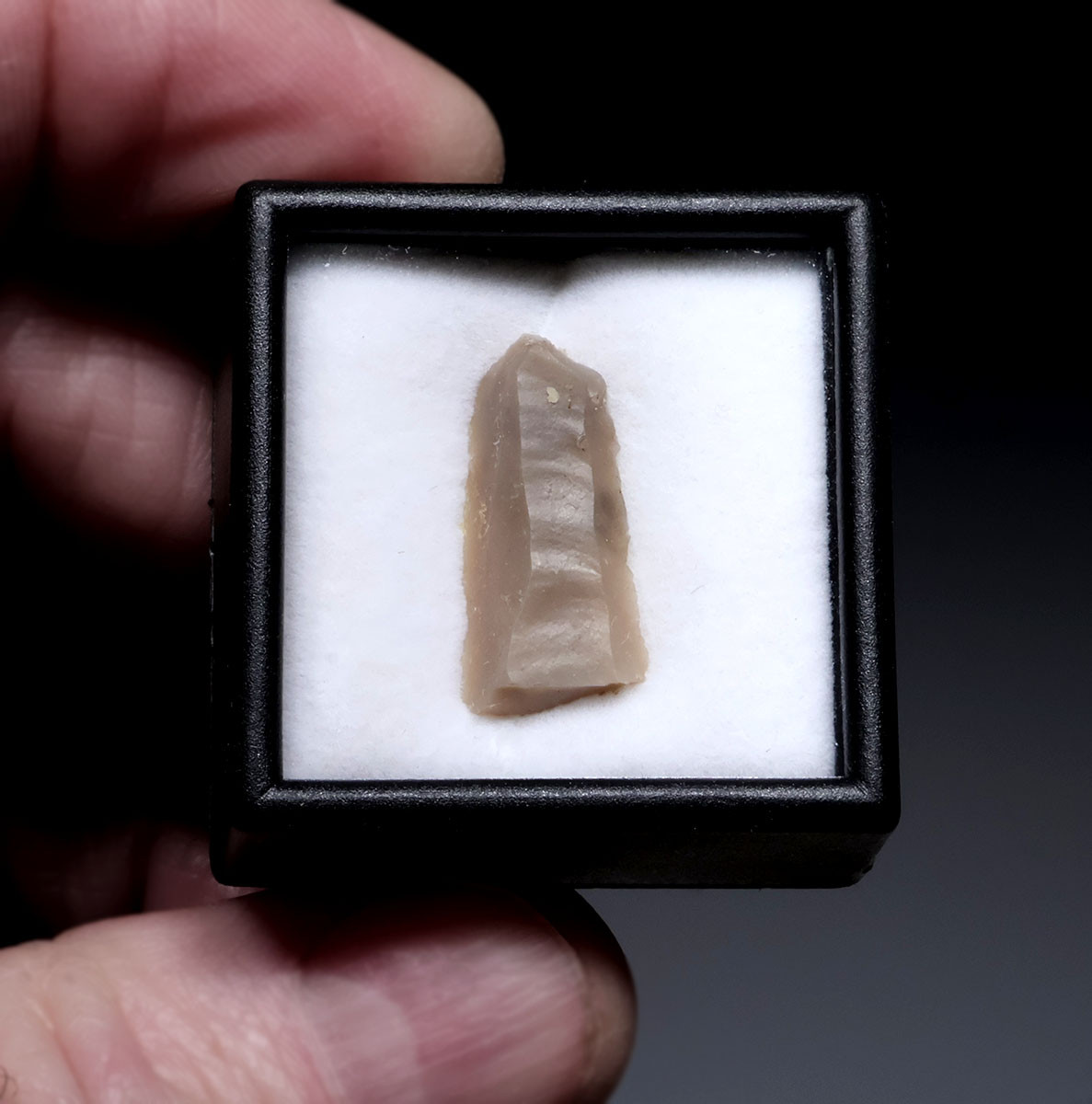
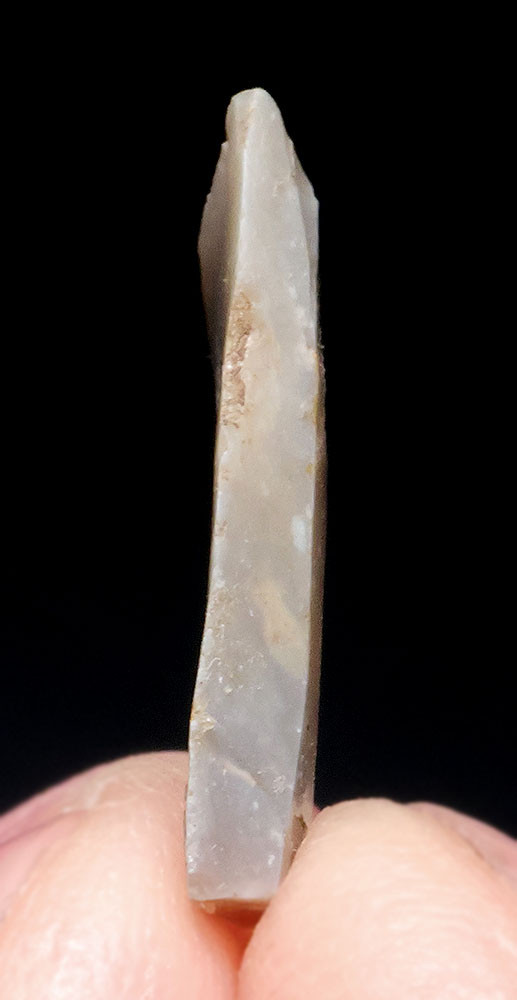
A RARE offering for the discriminating collector of scarce Paleolithic artifacts, this is a Tardenoisian Culture Mesolithic flint microlith blade flake tool found in Selmeston, England. It is ONE of only FOUR we have to offer and the only instance of us ever acquiring British Tardenoisian Culture tools. The Tardenoisian is an archaeological culture of the Mesolithic / Epipaleolithic period from Europe. It is named after the type site at Fère-en-Tardenois in the Tardenois region in France, where E. Taté first discovered its characteristic artifacts in 1885. These artifacts differ from earlier industries by the presence of geometric microliths, microburin, scalene triangles, trapezoids and chisel-ended arrowheads and small flint blades made by the pressure-technique. The Tardenoisian followed the Ahrensburgian, with which it was paralleled, and lasted from about 9000 BC until 4000 BC (in Britain) in the Neolithic.
During the final Ice Age, hunter-gatherers had to move frequently and follow the herds they hunted. Microblade technology was suitable for high mobility and rapid weapon production, as well as reducing failure of hunting and lost or damaged weapons. Instead of replacing an entire tool or weapon, a microblade component could be removed and replaced, saving time and resources. Mesolithic hunter-gatherers developed the technique of miniaturized and advanced lithic manufacture and weapons.
This flint microlith blade is complete with no modern damage and intact ancient deposits. The original founders collection label is still intact on the back side, as is some traces of old adhesive from it being glued to a card. It comes from a very old private British collection, and was found in the 1950's.
A microlith is a small stone tool usually made of flint or chert and typically a centimeter or so in length and half a centimeter wide. They were made by humans from around 35,000 to 3,000 years ago, across Europe, Africa, Asia and Australia. Microliths are produced from either a small blade (microblade) or a larger blade-like piece of flint by abrupt or truncated retouching, which leaves a very typical piece of waste, called a microburin. The microliths themselves are sufficiently worked so as to be distinguishable from workshop waste or accidents. An exceptional piece of evidence for the use of microliths has been found in the excavations of the cave at Lascaux in the French Dordogne. Twenty backed edge bladelets were found with the remains of a resinous substance and the imprint of a circular handle (a horn). It appears that the bladelets might have been fixed in groups like the teeth of a harpoon or similar weapon.
HISTORY
The MESOLITHIC or EPIPALEOLITHIC tool tradition describes the time between the Upper Paleolithic and Neolithic. It is the final period of hunter-gatherer cultures in Europe and Western Asia, between the end of the Last Glacial Period and the Neolithic Revolution. In Europe, it spans roughly 15,000 to 5,000 BP.
The Mesolithic is a milestone in human history as it marks the final age of the hunter-gatherer. The dawn of farming and widespread animal husbandry that would follow, would usher in what will be the most transformational era of Man, the ability to abandon a nomadic life to follow herds or rely on nature, ending a mobile survival-like existence, to focus on the development of civilization and city-building.
The Mesolithic marks the highest refinement of the tool kit of the hunter-gatherer. As humans followed and hunted herds of animals, their tools had to become as mobile as possible. Here we have the full miniaturization of flake tools, something we saw starting to occur in the Upper Paleolithic. The extensive use of MICROBLADES was a hallmark of the Mesolithic. Microblade technology is a period of technological development marked by the creation and use of small stone prismatic blades which are produced by chipping silica-rich stones like chert, quartz, or obsidian. Microblades are a specialized type of lithic flake that are at least twice as long as they are wide. The blades were used in various tools and weapons as replaceable bladelets.
During the final Ice Age, hunter-gatherers suffered from shortage of food resources with increased human populations and depleted wild game herds. This required hunter-gatherers to move frequently and follow the herds they could locate. Microblade technology was suitable for high mobility and rapid weapon production, as well as reducing failure of hunting and lost or damaged weapons. Instead of replacing an entire tool or weapon, a microblade component could be removed and replaced, saving time and resources. Mesolithic hunter-gatherers invested more time acquiring better raw materials and developing the technique of miniaturized and advanced lithic manufacture and weapons.


