 US DOLLAR
 EURO
EURO
 AUSTRALIAN DOLLAR
 CANADIAN DOLLAR
 POUND STERLING




Product Description
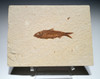
While this is a common fish fossil of the Eocene, it is a premium display specimen. This is a premium specimen of a prehistoric fish called a Knightia sp., a member of the same family as the herring and sardine. This fossil comes from the Green River Formation in southwest Wyoming, and dates back 50 million years ago. The fossil fish is on its original thick, unbroken limestone plate. This is not an inferior negative impression often sold - you can see the bones and rays of fins on the stone surface.
An affordable yet, top quality and highly displayable fish fossil from the United States!
HISTORY
Knightia is an extinct genus of clupeid bony fish that lived in the freshwater lakes and rivers of North America and Asia during the Eocene epoch. The genus was erected by David Starr Jordan in 1907, in honor of the late University of Wyoming professor Wilbur Clinton Knight, "an indefatigable student of the paleontology of the Rocky Mountains." It is the official state fossil of Wyoming, and the most commonly excavated fossil fish in the world.
Knightia belongs to the same taxonomic family as herring and sardines, and resembled the former closely enough that both Knightia alta and Knightia eocaena were originally described as species of true herring in the genus Clupea. As with modern-day clupeids, Knightia spp. likely fed on algae and diatoms, as well as insects and occasionally smaller fish. A small schooling fish, Knightia made an abundant food source for larger Eocene predators. The Green River Formation has yielded many fossils of larger fish species preying on Knightia; specimens of Diplomystus, Lepisosteus, Amphiplaga, Mioplosus, Phareodus, Amia, and Astephus have all been found with Knightia in either their jaws or stomachs.