US DOLLAR
 EURO
EURO
 AUSTRALIAN DOLLAR
 CANADIAN DOLLAR
 POUND STERLING







Product Description
For comparison prices, please see the "Old World Typology and Price Guide" section of the "OVERSTREET IDENTIFICATION AND PRICE GUIDE TO INDIAN ARROWHEADS" editions 7th, 8th and 9th.
SEE MORE MOUSTERIAN NEANDERTHAL TOOLS
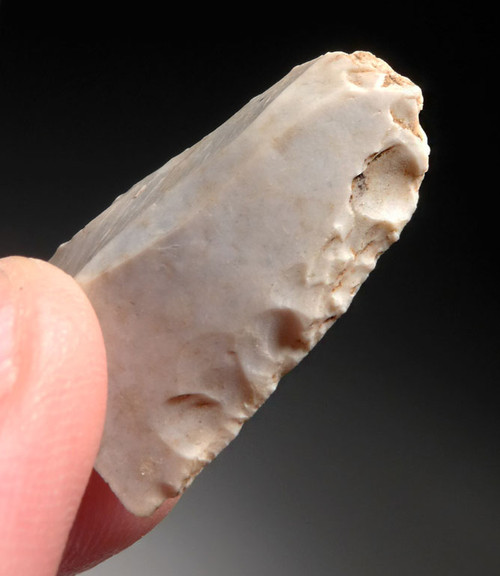
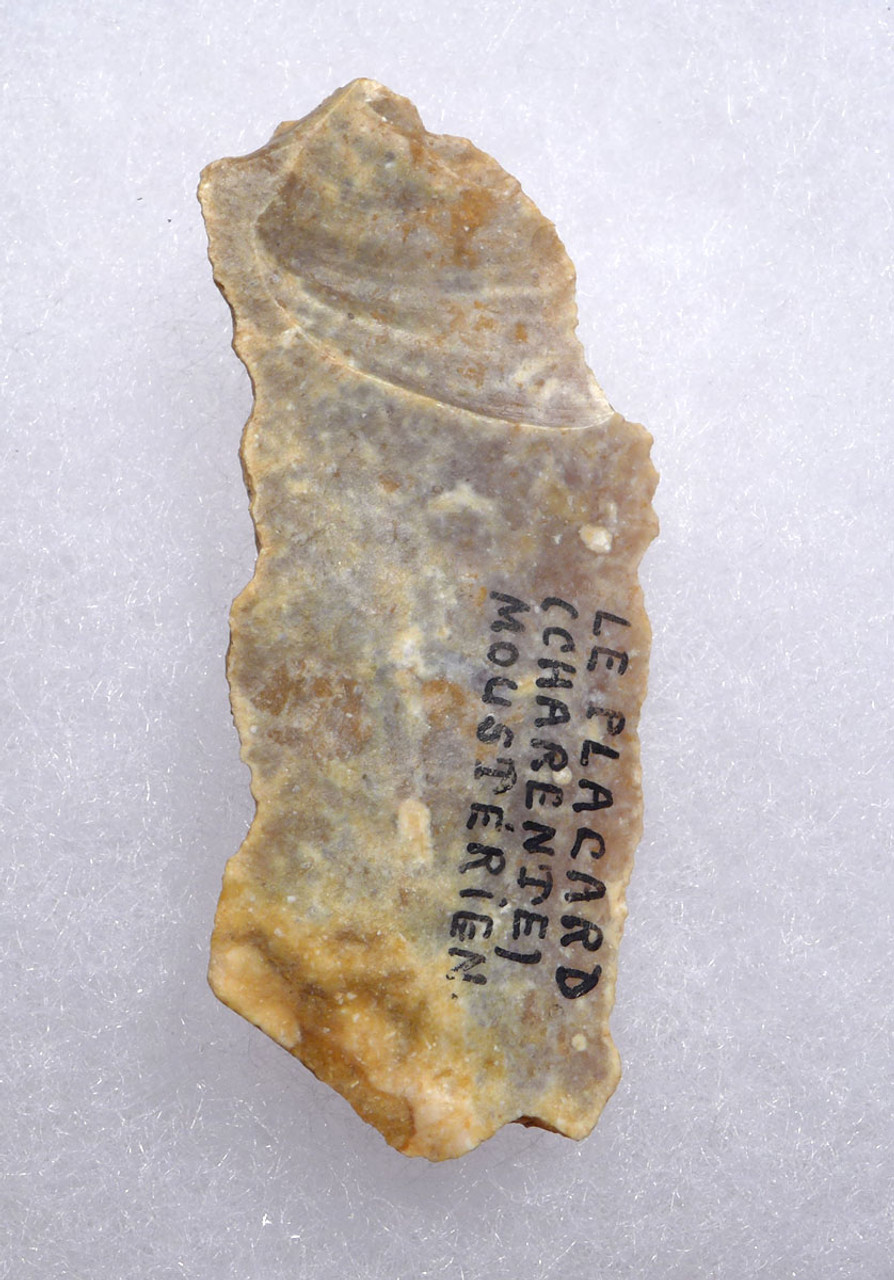
This is a rare Mousterian flake tool from the Middle Paleolithic, of the type called a STRUCK BLADE. It is complete as originally made, and shows evidence of use. This flint flake tool was made by Neanderthal humans who once lived in this famous decorated cave site of Grotte du Placard before the Cro-Magnon humans later occupied the cave and decorated the cave with the art it is known for. Most of the material collected was from the Upper Paleo Cro-Magnon levels making this a rare opportunity to acquire a specimen that was very limited in numbers from the large collection we acquired.
Grotte du Placard is a major archaeological site that has been closed and protected from any private excavations, for many, many decades making this specimen rare and desirable with strong future appreciation in price. Artifacts from all Paleolithic cave sites in Europe can only be legally acquired from very old private collections as this piece came from.
This Mousterian Middle Paleolithic Neanderthal flint tool is an excellent specimen with traits only found on authentic specimens - no modern flaking or crushing, and prehistoric mineralized sediment deposits in micro-crevices and flake scars.
The Grotte du Placard or (the Placard Cave), was first discovered in 1853. It is a very famous prehistoric cave in Charente, France containing art made by humans over 17,000 years ago. It is one of the most important Stone Age cave sites housing prehistoric cave art with abstract signs (aviforms), dating back to the era of Solutrean art. Traditionally grouped together with three other archeological sites of Franco-Cantabrian cave art, all four of the sites contain similar bird-like abstract symbols. The other sites include Pech Merle Cave (25,000 BCE), Cougnac Cave (23,000 BCE), and Cosquer Cave (25,000 BCE). Because Placard Cave is the only one of the four rock shelters whose rock art has been directly dated (to 17,500-18,000 BCE), the strange aviforms it contains are now known as "Placard-type signs", even though the earliest art of this type was created at Pech Merle, during the Gravettian.
HISTORY
The Grotte du Placard has been extensively excavated with more than a dozen levels dating from the Middle Paleolithic to later, higher levels Upper Paleolithic layers, especially Magdalenian and Solutrean Periods. The French Association for the Advancement of Science funded early excavations in 1902. The subdivisions of the Upper Paleolithic presented by Henri Breuil the 1912 Geneva Convention are partly based on the results of excavations of the Grotte du Placard. Excavations were also done in 1958 by Jean Roche at the request of Jean Piveteau and again, in 1987 following the discovery of a reindeer and cattle engravings and a not yet excavated gallery. Human remains have been found in this cave including Neanderthal and mostly, Cro-Magnon. Many bones of Homo sapiens dating from the Solutrean ( Upper Paleolithic ) have been found, including skulls fashioned into cups. A frieze of about 5 meters long was excavated in 1990 on the walls buried in the Solutrean layer. The drawings are made by very fine incisions. Many horses, deer, ibex, deer, chamois, a saiga of cattle, aurochs and a two buffalo heads sticking out their tongues, are represented. Sieving the excavated material allowed recovery of 640 carved stones, which showed that all of the walls were engraved. A dozen "bird-shaped" signs are also present. Painted red, they are identical to those found in the caves of Pech Merle and Cougnac. This suggests a cultural group or a common artist(s) attended these remote caves of over 150 km apart. Similar signs were found in the Cosquer cave in Marseille, 500 km away.