 US DOLLAR
 EURO
EURO
 AUSTRALIAN DOLLAR
 CANADIAN DOLLAR
 POUND STERLING







Product Description
SEE MORE PRE-COLUMBIAN ARTIFACTS
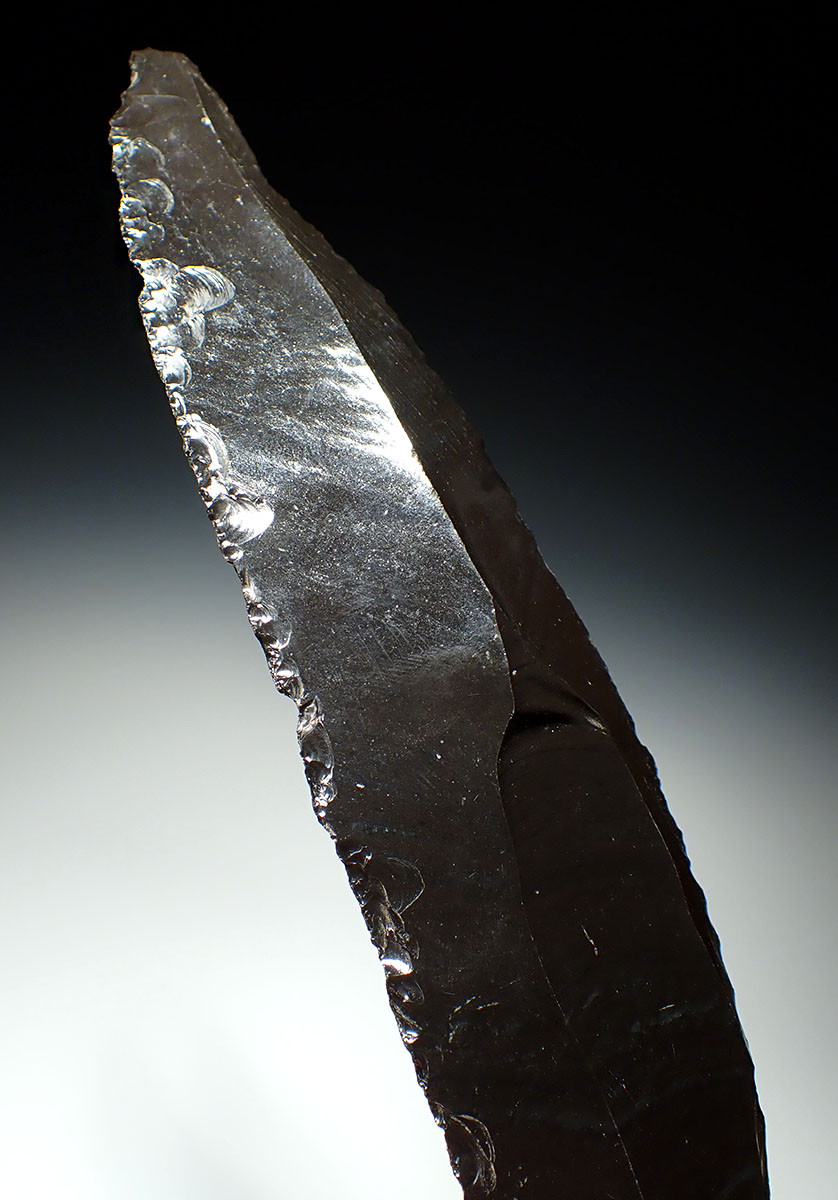
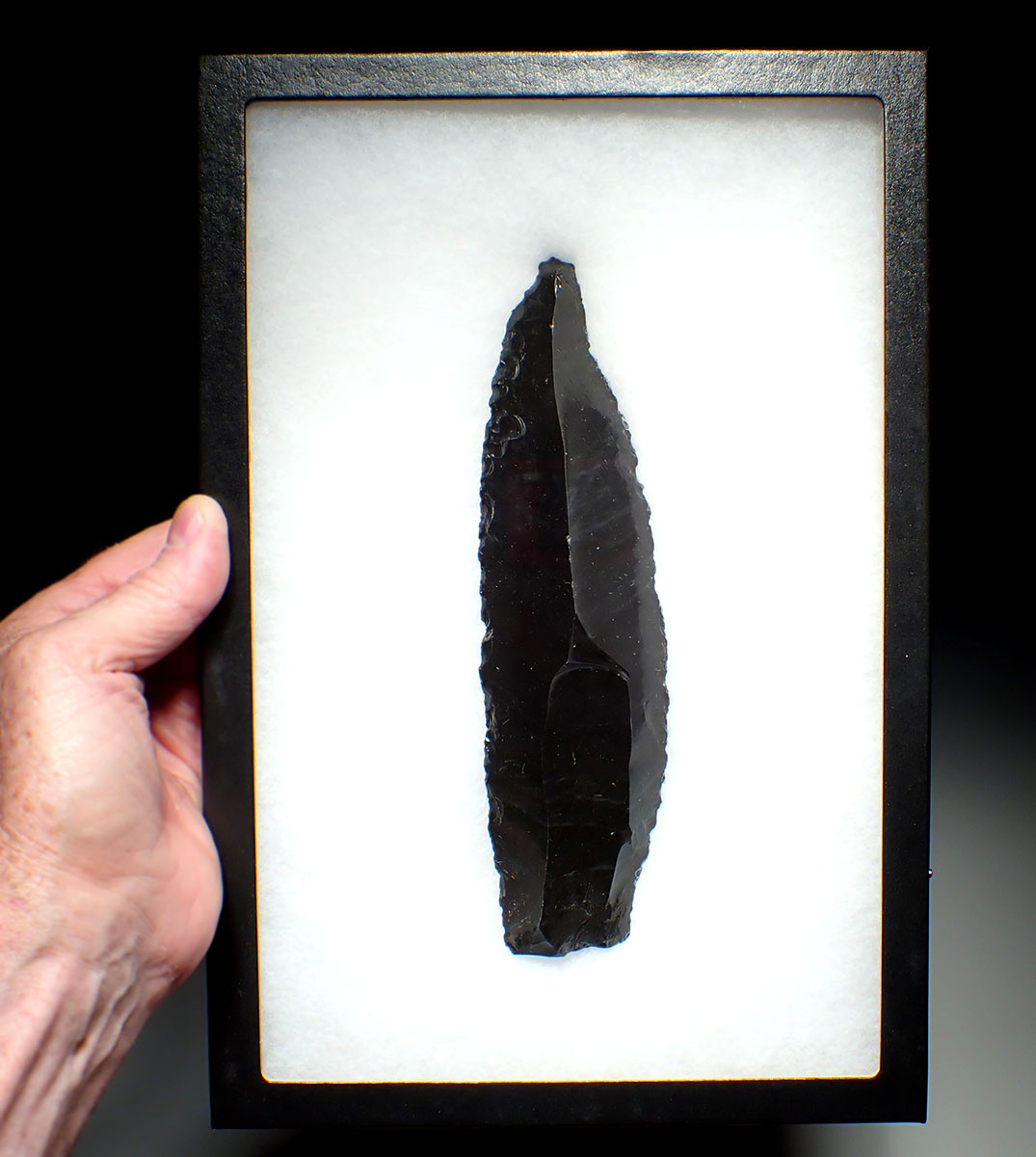
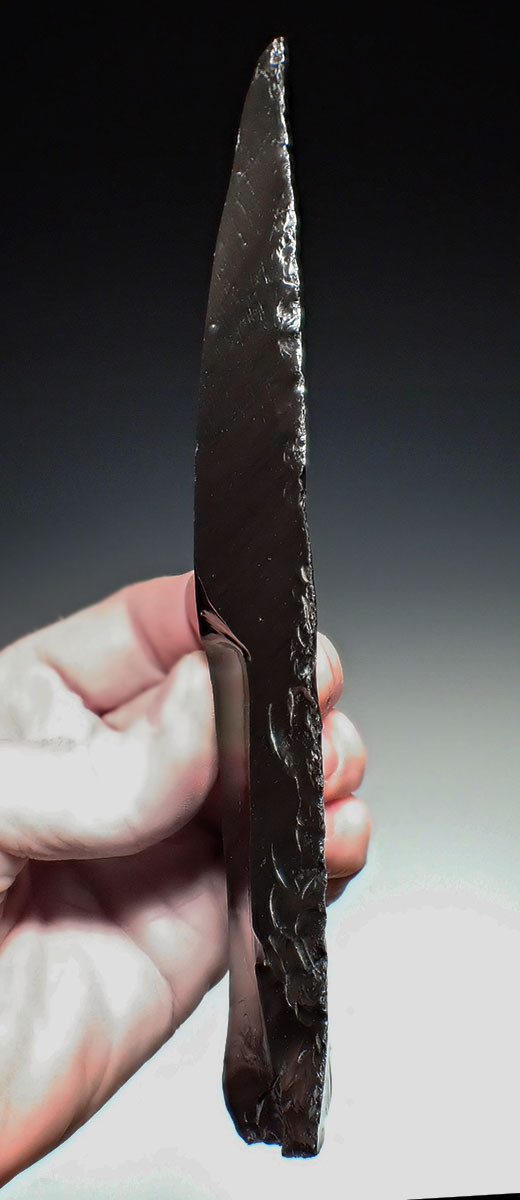
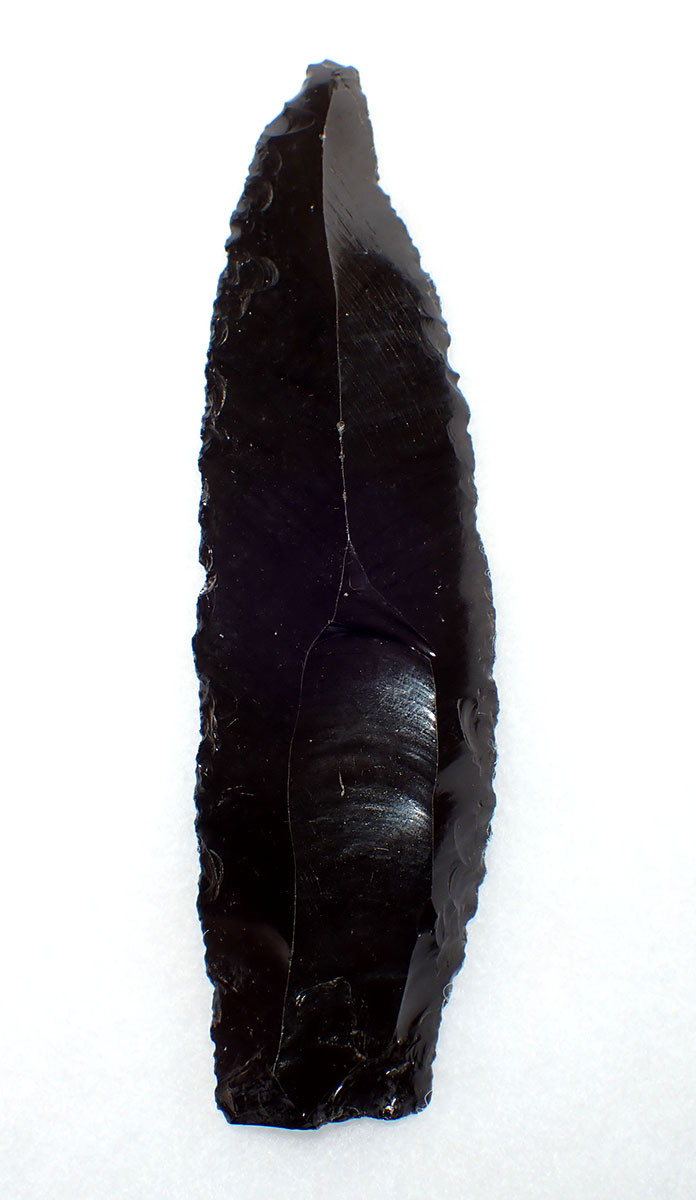
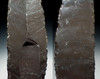
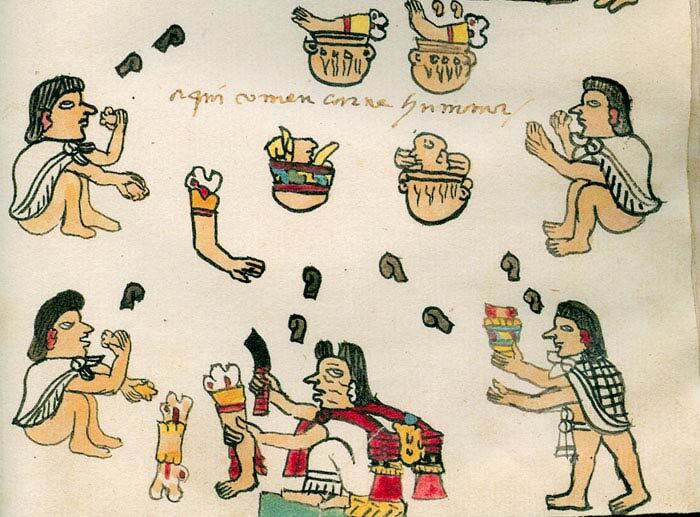
This EXTRAORDINARY, large unifacial obsidian blade comes from the Pre-Columbian Aztec Empire. Its size and extensive re-sharpening, with a reduced base for hafting onto a handle, a blade like this would have been necessary for the common practice of dismemberment of the human body of a sacrifice victim for distribution and cannibalism. Such practice is not only well-documented in many Aztec codices, but recent archaeological discoveries in Mexico have unearthed several different sites with deposits of human bones of men, women and children, that show evidence of butchering and de-fleshing. Dismemberment of the human body would require cutting through some of the heaviest ligaments and muscles to separate limbs as seen in the codices. This blade is of the size that would be needed for such a gruesome task. The finely serrated cutting edge shows extensive ancient sharpening to create a cutting edge that would have been necessary to sever strong connective tissue such as cartilage and large muscle, as well as for major de-fleshing tasks.
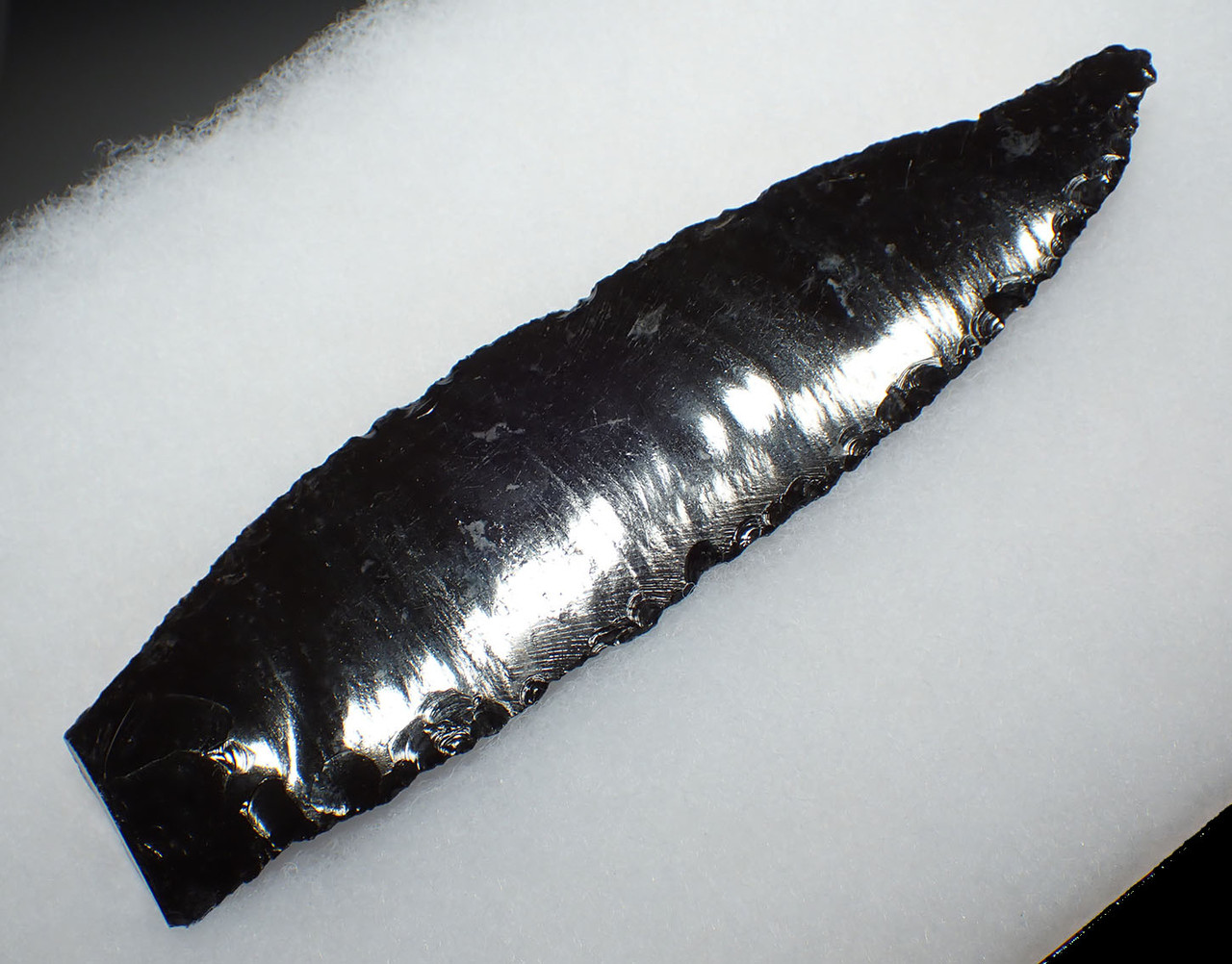
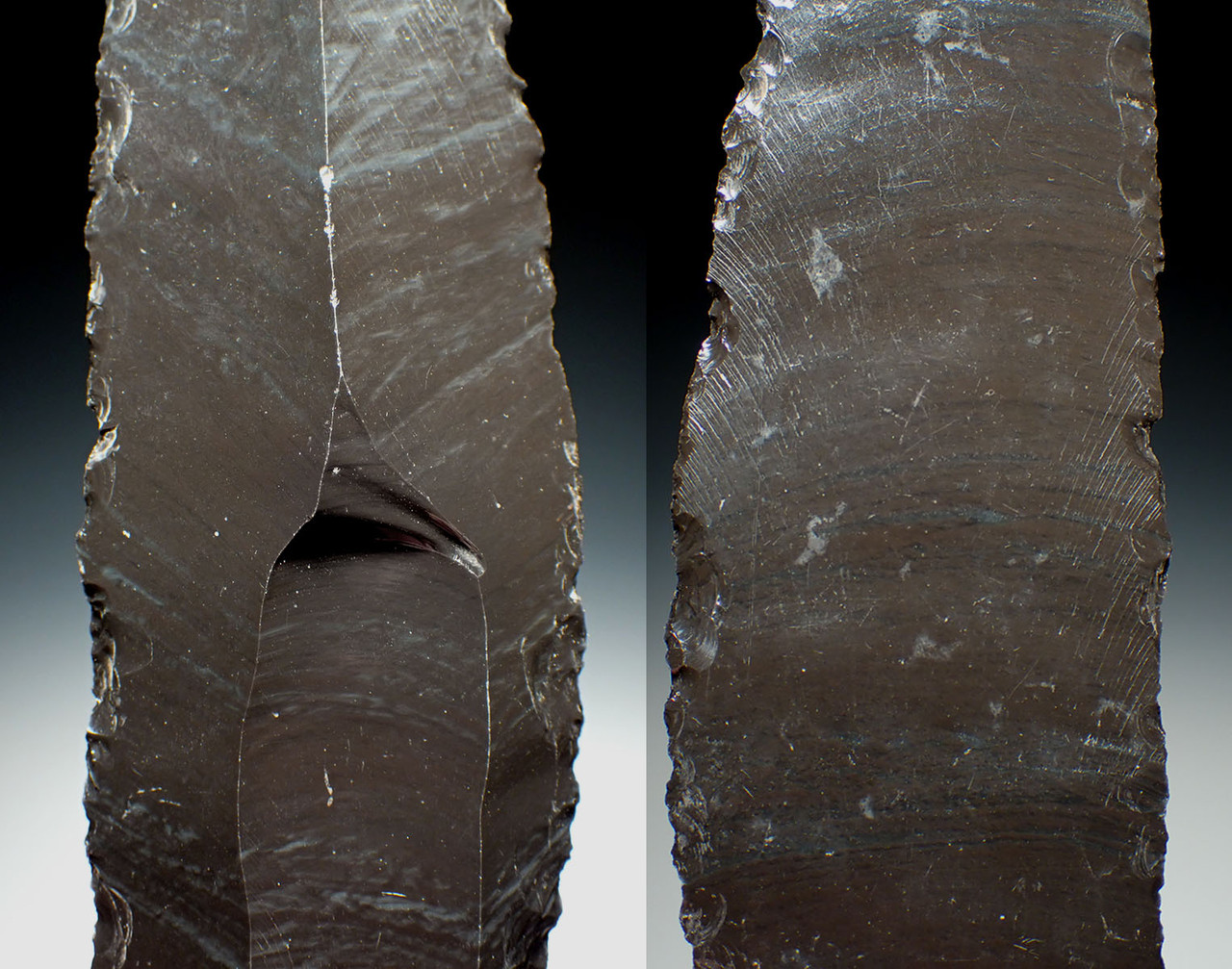
In perfect complete form, this massive blade is made from a unique very dark blackish, gray brown banded obsidian. The last photo shows a closeup of the material. The cutting edges are perfect and in original condition with no damage, ancient or modern. In our many decades of working with this material, this is one of the largest obsidian unifacial Pre-Columbian butchering blades we have seen. The end is pointed which would have allowed the knife blade to have the ability to puncture, as well as cut. The surface is extremely glossy from soil sheen, highlighting the incredible workmanship and form of this exceptional specimen.
Obsidian was prized by the ancient Pre-Columbian Indians and even today, it is still used in modern medicine for scalpel blades as obsidian can flake to an edge one molecule thick, thereby attaining a level of sharpness impossible to achieve with a steel scalpel. As a matter of fact, aside from using lasers in modern surgery, the preferred scalpel is one from obsidian. Because of its sharpness, obsidian leaves less of a scar and does less tissue damage than a scalpel or knife made of any other substance known to Man. Obsidian is 15 times sharper than surgical steel, It’s no wonder that obsidian became a valuable tool in medicine and warfare when you consider that at an obsidian scalpel can rival diamond in the fineness of its edge. Common household razor blades are 100 times thicker than obsidian!
Ancient mineral deposits can be seen deep in the flake scars of this obsidian artifact which is an indicator ONLY found in AUTHENTIC specimens such as this. Caution must be applied in acquiring AUTHENTIC ancient obsidian artifacts because the stone does not patinate on the surface like other lithic types.
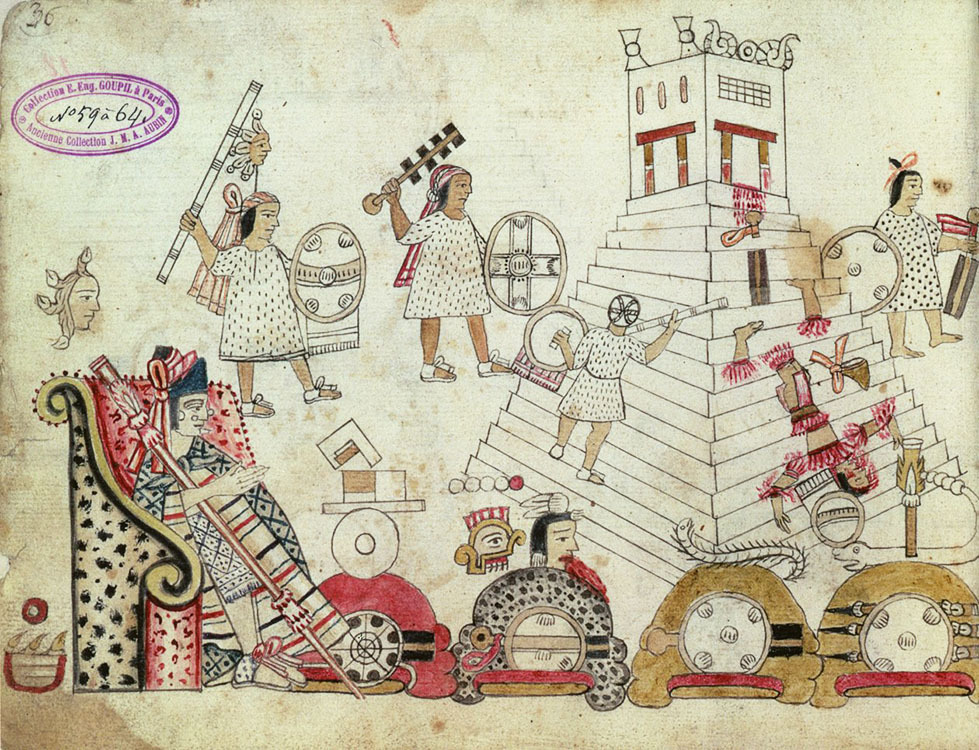
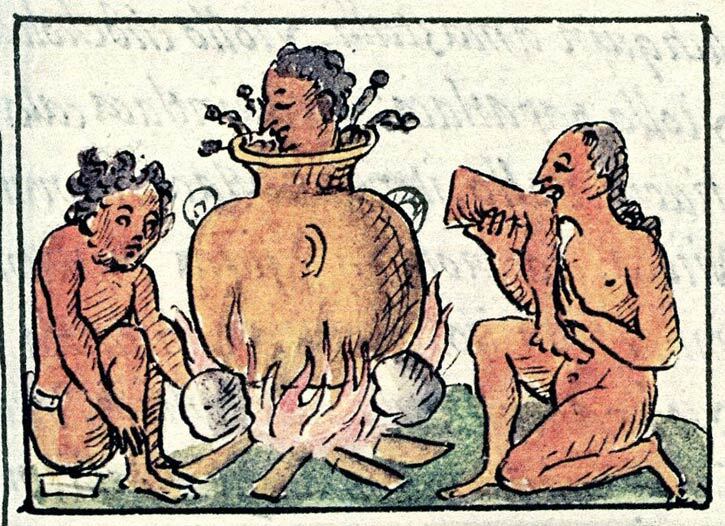
Various Aztec codices are shown below depicting the common practice that accompanied human sacrifice - dismemberment and cannibalism.
HISTORY
Documentation of Aztec cannibalism mainly dates from the period after the Spanish conquest of the Aztec Empire (1519-1521). For instance, a convoy ordered by Diego Velázquez de Cuéllar was cannibalized by the Aztecs in Zultépec-Tecoaque in 1520. In the Nahuatl language, the name "Tecoaque" translates into "the place where they ate them." For eight months, the convoy was ritually sacrificed, and their heads were put up on skull racks known as tzompantli. Both men and women were sacrificed, including pregnant women. At least one 3-or-4-year-old child was also sacrificed during the ritual, and the town's population swelled to 5,000 as people arrived for the ceremonies. In 1521, Hernán Cortés and his forces arrived and, in an act of revenge, massacred the town's inhabitants, who were mostly women and children.
In his book Relación (1582), Juan Bautista de Pomar (c. 1535 – 1590) states that after the sacrifice, the body of the victim was given to the warrior responsible for the capture. He would boil the body and cut it into pieces to be offered as gifts to important people in exchange for presents and slaves. Bernal Díaz reports that some of these parts of human flesh made their way to the Tlatelolco market near Tenochtitlan.
Bernal Díaz's True History of the Conquest of New Spain (written by 1568, published 1632) contains several accounts of cannibalism among the people the conquistadors encountered during their warring expedition to Tenochtitlan. About the city of Cholula, Díaz wrote of his shock at seeing young men in cages ready to be sacrificed and eaten. In the same work, Diaz mentions that the Cholulan and Aztec warriors were so confident of victory against the conquistadors in an upcoming battle the following day that "they wished to kill us and eat our flesh, and had already prepared the pots with salt and peppers and tomatoes." About the Quetzalcoatl temple of Tenochtitlan, Díaz wrote that inside, there were large pots where the human flesh of sacrificed Natives was boiled and cooked to feed the priests. About the Mesoamerican towns in general Díaz wrote that some of the indigenous people he saw were "eating human meat, just like we take cows from the butcher's shops, and they have in all towns thick wooden jail-houses, like cages, and in them they put many Indian men, women and boys to fatten, and being fattened they sacrificed and ate them."
While many ancient civilizations remain a mystery, little can be left to conjecture when it comes to the details of the Aztec way of life. An extensive and detailed collection of written and pictorial records exist for us today called CODICES (CODEX if singular) were produced before Spanish contact by the native tribes themselves, and afterwards during the Colonial period. These codices were created by the Aztecs in pictorial form, as well as by other indigenous tribal sources, all of which had no written language. Colonial era codices exist in greater number with roughly 500 separate codices known, showing extensive pictograms as well as being written in Spanish, Latin and in the original Nahuatl language.
The origin of the Aztec (Azteca) Empire is legendary. Aztec codices record that they began their wandering journey in 1100 A.D. emerging from their former homeland called Aztlan or "place of the herons", an island in a lake where men went out to fish from boats. The exact location of this region is not known but other than it was northwest of present-day Mexico City, the former center of the Aztec empire, but how far, it is a mystery.
The Aztecas believed they were guided by a blood-thirsty deity they called Huitzilopochtli who communicated to them through four priest-chieftains called teomama. Their god called upon them for his insatiable thirst for human blood and sacrifice. As they migrated south, every indigenous Indian tribe they encountered along the way abhorred the Azteca, as they were known, as they were reviled and scorned for their violent and barbaric ways. During their migration, Huitzilopochtli gave a message to his people that their new identity would no longer be known as Azteca but as Mexica. In around 1325 A.D., as they were fleeing an altercation with the Culhuacans, they were driven to a marsh. Their god Huitzilopochtli consoled them that evening and said he would end their wandering and told them to look for a sign that he will give them that will signify their new homeland which will be "the place of the cactus and the eagle I now name Tenochtitlan". They next day they witnessed an eagle resting on a prickly pear cactus which they interpreted to be the sign they were hoping for.
This marsh, Lake Texcoco, would later become a vast canal-laced highly advanced, super city of stone pyramids and temples known as Tenochtitlan. With a population that grew to an estimated 200,000 people (three times the largest city of Spain at the time!) this became the center of the most powerful and militaristic empire of Mesoamerica - home of the Aztecs. Today, we classify their reign as occupying the Late Post Classic Period from 1250 - 1521 A.D.
References:
- Fiedel, Stuart J., Prehistory of the Americas, 1992 - Freeman and Company, Early Man in America, 1973
- Hirth Kenneth, Obsidian Craft Production in Ancient Central Mexico, 2006
- Muser, Curt, Facts and Artifacts of Ancient Middle America, 1978
- Phillips, Charles, The Complete Illustrated History of the Aztec and Maya, 2008
- Pohl, John M.D., Aztec, Mixtec and Zapotec Armies. Oxford: 1991
- Schmal, John P., The History of the Indigenous Sinaloa. 2004 - Stuart, Gene, The Mighty Axtecs, 1981

