 US DOLLAR
 EURO
EURO
 AUSTRALIAN DOLLAR
 CANADIAN DOLLAR
 POUND STERLING








Product Description
SEE MORE ANCIENT NEAR EASTERN ARTIFACTS
SEE MORE ANCIENT SCYTHIAN ARTIFACTS
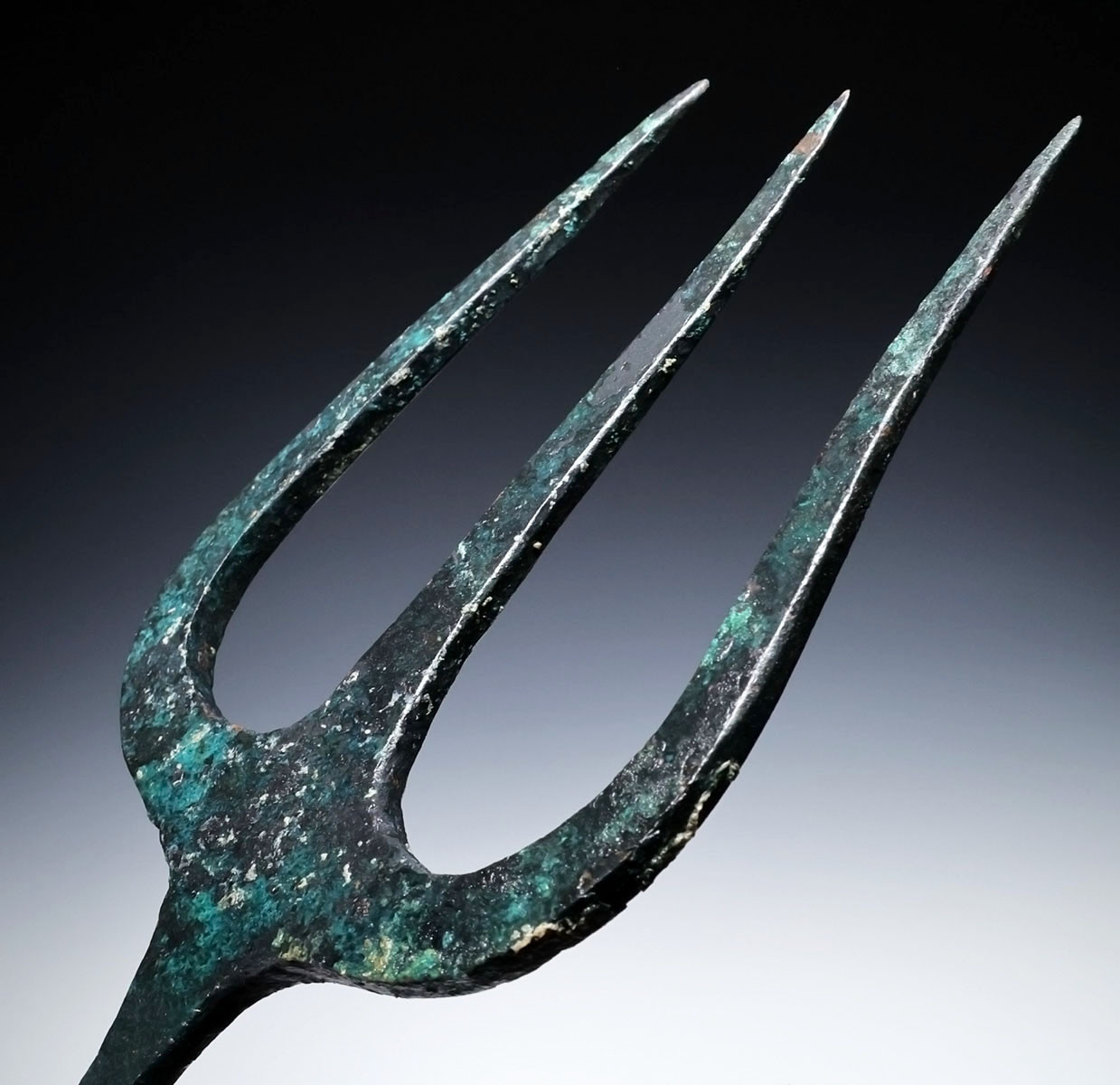
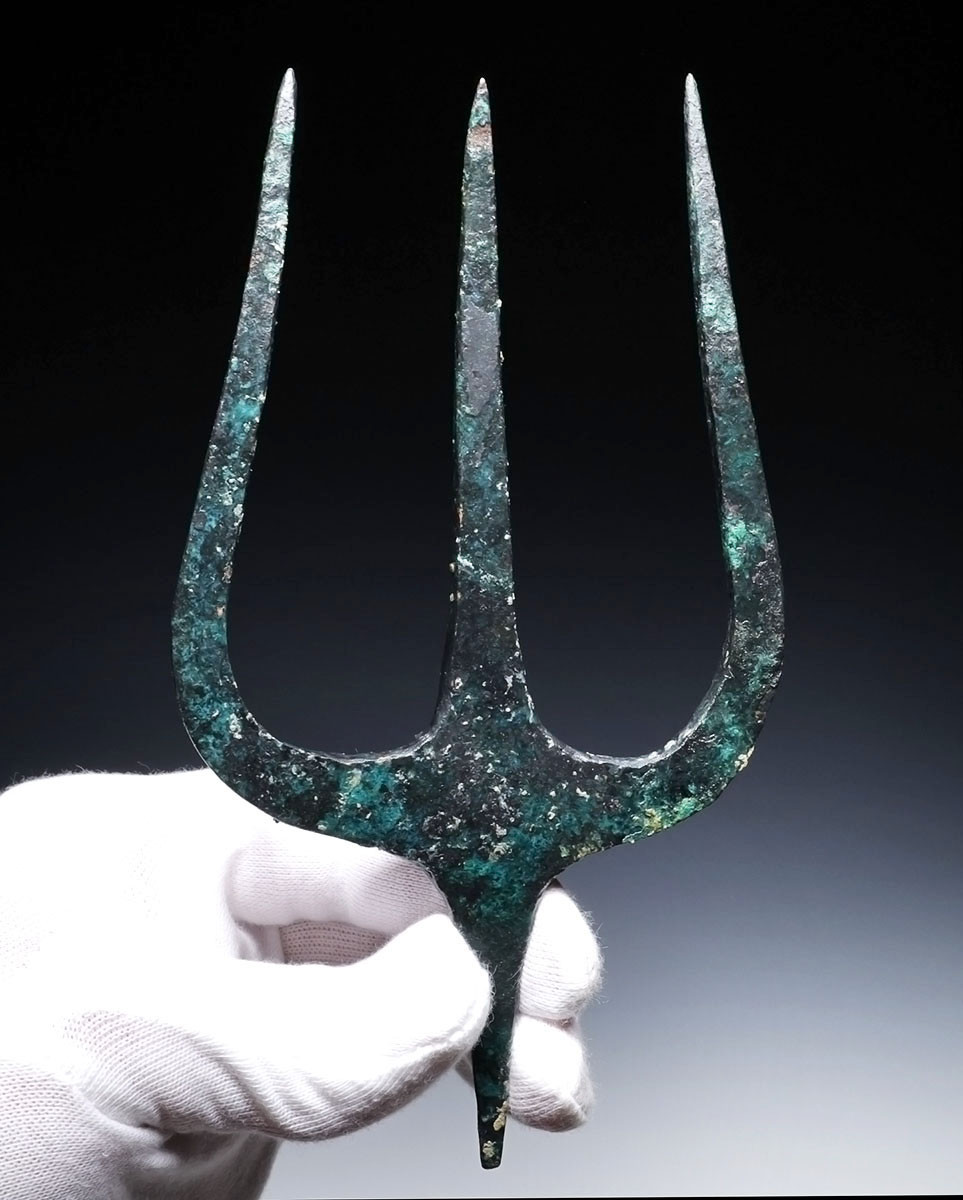
Ancient Saka Indo-Scythian bronze weapons are ULTRA-RARE and their absence in any collection, private or institutional, proves that. Adding to the unique opportunity of what culture this weapon belongs to, this type of weapon is an even greater rarity. It is a complete and perfectly preserved fighting trident specifically designed for war. Based on its extreme scarcity, such a weapon was most certainly reserved for only the highest noble warriors or tribe chieftains. This is one of only 4 we have ever had and it is THE LAST ONE WE HAVE TO OFFER!
Fighting tridents of this early age would later give rise to the war fork that was used later in combat by the Chinese, and also in India as can be seen in the hand of the six-headed depiction of Kartikeya, the Hindu god of war. Much later in Medieval Europe, the war fork would become a feared pole arm on the battlefield.
Fighting tridents were used as highly feared and effective weapons, able to penetrate scale, lamellar and leather armor. They were "terror weapons", intended to intimidate the enemy as the wound produced by these triple-pointed spears would have inflicted THREE stab wounds simultaneously with each thrust, and likely deadly with their ability for deep penetration. War tridents can be distinguished from ordinary fishing tridents by the absence of barbs on the tips. Fishing tridents needed barbed tips to hold the impaled fish on the fork when pulled from the water.
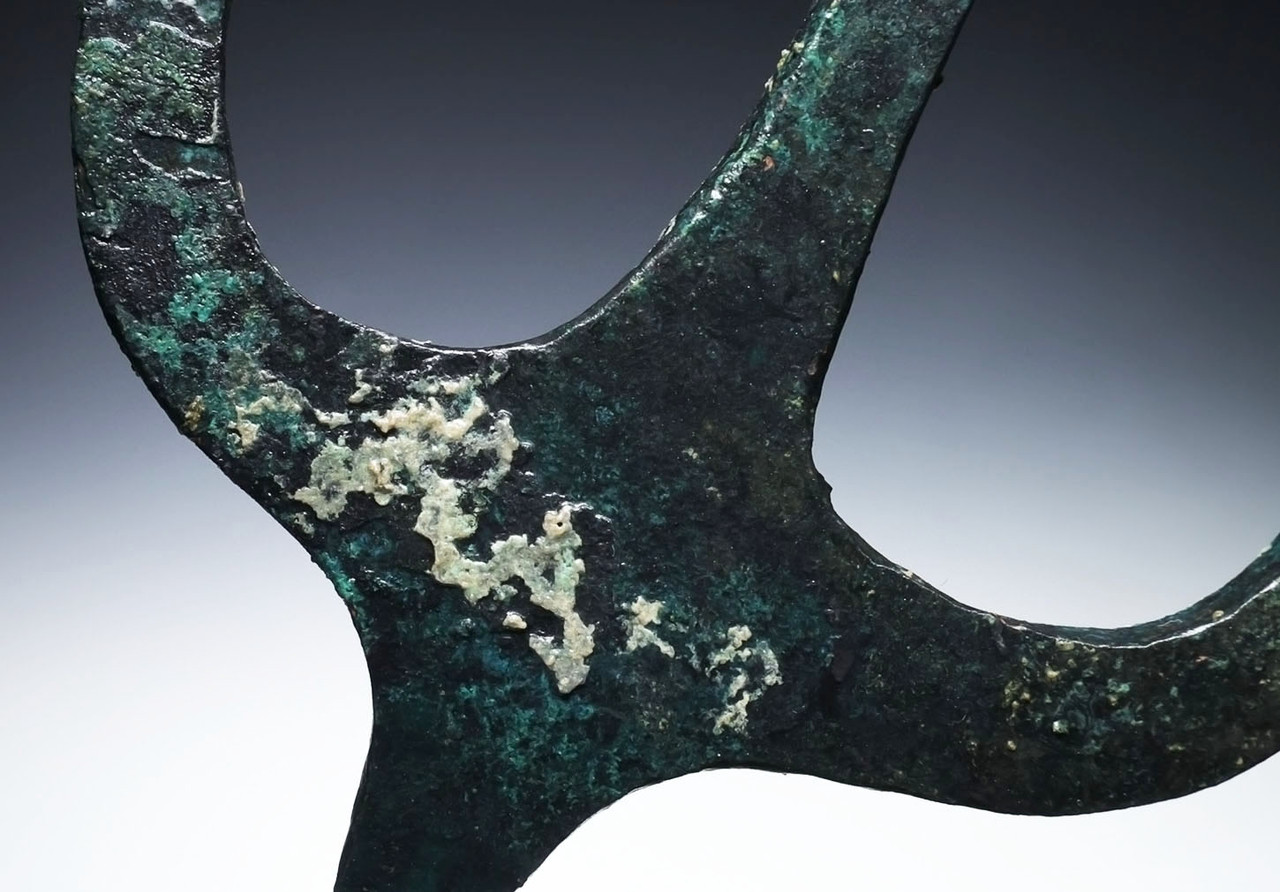
Made of forged bronze, such a weapon would have been strong enough to use in a combat role without the tines breaking like iron would have. The hammer-forging of this bronze trident made the bronze extremely hard but still more malleable than iron, able to easily be straightened and repaired, unlike if in iron. When new, the bronze would have had a more intimidating effect, gleaming bright gold in the sun. This large trident shows spectacular preservation with heavy patina and mineral encrustations. It is in rare, undamaged and complete preservation.
IMPRESSIVE AND EXTREMELY RARE FOR THE ULTIMATE ANCIENT WEAPON COLLECTION!
This artifact has been professionally cleaned and conserved in our lab, being treated with a special sealer developed and formulated by us specifically for ancient metal preservation. The patina shows beautiful traits only found in authentic ancient weapons such as a layered mineralized patina with encrustations. There is no active bronze disease. Bronze disease can be a problem in bronze artifacts and if left untreated, can literally destroy a piece over time.
WARNING: There is an increasing number of fake Near Eastern (Luristan) bronze weapons on the market. As fine quality intact, original specimens become more scarce and techniques have become more sophisticated to fake these weapons. We have personally handled numerous extremely well-done fakes with extremely convincing patinas. The degree to which the fakers have been able to replicate patina to disguise their work requires an expert examination by highly experienced individuals. It is common to find very reasonably priced weapons that are made up of part original and part modern components or wholly modern pieces displaying elaborate artificial patinas. All purchases should include from the dealer a written guarantee of authenticity with unconditional and lifetime return policies regarding such guarantee.
HISTORY
The Saka were a group of nomadic Iranian peoples who historically inhabited the northern and eastern Eurasian Steppe and the Tarim Basin. Though closely related, the Sakas different from the Scythians of the Pontic Steppe and the Massagetae of the Aral Sea region, though they all form part of the wider Scythian cultures. Like the Scythians, the Sakas were ultimately derived from the earlier Andronovo culture. The Sakas were a group of Iranic peoples who spoke a language belonging to the Iranian branch of the Indo-European languages. The Saka were racially Europoid.
Historical records and scientific studies date the Saka as early as the 8th century BC. In the Achaemenid-era,ancient Persian inscriptions found at Persepolis, dated to the reign of Darius I (r. 522-486 BC), record the Saka as having lived just beyond the borders of Sogdia. An inscription dated to the reign of Xerxes I (r. 486-465 BC) has them associated with the Dahae people of Central Asia.
In the 2nd century BC, many Sakas were driven by the Yuezhi from the steppe into Sogdia and Bactria and then to the northwest of the Indian subcontinent, where they were known as the Indo-Scythians. Other Sakas invaded the Parthian Empire, eventually settling in Sistan, while others may have migrated to the Dian Kingdom in Yunnan, China. In the Tarim Basin and Taklamakan Desert region of Northwest China, they settled in Khotan, Yarkand, Kashgar and other places, which were at various times vassals to greater powers, such as Han China and Tang China.
The art of the Saka was of a similar styles as other Iranian peoples of the steppes, which is referred to collectively as Scythian art. Ancient influences from Central Asia became identifiable in China following contacts of metropolitan China with nomadic western and northwestern border territories from the 8th century BC. The Chinese adopted the Scythian-style animal art of the steppes (descriptions of animals locked in combat), particularly the rectangular belt-plaques made of gold or bronze, and created their own versions in jade and steatite.
Following their expulsion by the Yuezhi, some Saka may also have migrated to the area of Yunnan in southern China. Saka warriors could also have served as mercenaries for the various kingdoms of ancient China. Excavations of the prehistoric art of the Dian civilization of Yunnan have revealed hunting scenes of Caucasoid horsemen in Central Asian clothing.

