 US DOLLAR
 EURO
EURO
 AUSTRALIAN DOLLAR
 CANADIAN DOLLAR
 POUND STERLING


Product Description
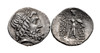
This genuine ancient Greek silver Stater coin was minted in Thessaly during the mid-late 1st Century BC. It comes from the Hellenistic Thessalian League and was issued by the magistrates Polyxenos and Eukolos. The obverse shows the head of Zeus wearing an oak wreath crown. The reverse shows the standing war goddess Athena Itonia advancing right, holding a shield and preparing to throw a spear. BCD Thessaly I –; BCD Thessaly II 846; HGC 4, 210. Beautifully toned with minor roughness. Very Fine. From the esteemed BCD collection.
BCD are the initials of a collector who wishes to remain anonymous. One of the largest collections ever formed, including great rarities and coins of superb quality, portions of the BCD collection have been sold in multiple auctions held by several different numismatic firms. As a result of BCD 's superb scholarly research, the auction catalogs for his collection have become primary references.
HISTORY
Ancient Greece was a northeastern Mediterranean civilization, existing from the Greek Dark Ages of the 12th–9th centuries BC to the end of classical antiquity (c. 600 AD), that comprised a loose collection of culturally and linguistically related city-states and communities. Prior to the Roman period, most of these regions were officially unified only once under the Kingdom of Macedon from 338 to 323 BC. In Western history, the era of classical antiquity was immediately followed by the Early Middle Ages and the Byzantine period.
Three centuries after the decline of Mycenaean Greece during the Bronze Age collapse, Greek urban poleis began to form in the 8th century BC, ushering in the Archaic period and the colonization of the Mediterranean Basin. This was followed by the age of Classical Greece, from the Greco-Persian Wars to the death of Alexander the Great in 323 BC, and which included the Golden Age of Athens and the Peloponnesian War between Athens and Sparta. The unification of Greece by Macedon under Philip II and subsequent conquest of the Achaemenid Empire by Alexander the Great spread Hellenistic civilization across the Middle East. The Hellenistic period is considered to have ended in 30 BC, when the last Hellenistic kingdom, Ptolemaic Egypt, was annexed by the Roman Republic.
Classical Greek culture, especially philosophy, had a powerful influence on ancient Rome, which carried a version of it throughout the Mediterranean and much of Europe. For this reason, Classical Greece is generally considered the cradle of Western civilization, the seminal culture from which the modern West derives many of its founding archetypes and ideas in politics, philosophy, science, and art.