 US DOLLAR
 EURO
EURO
 AUSTRALIAN DOLLAR
 CANADIAN DOLLAR
 POUND STERLING









Product Description
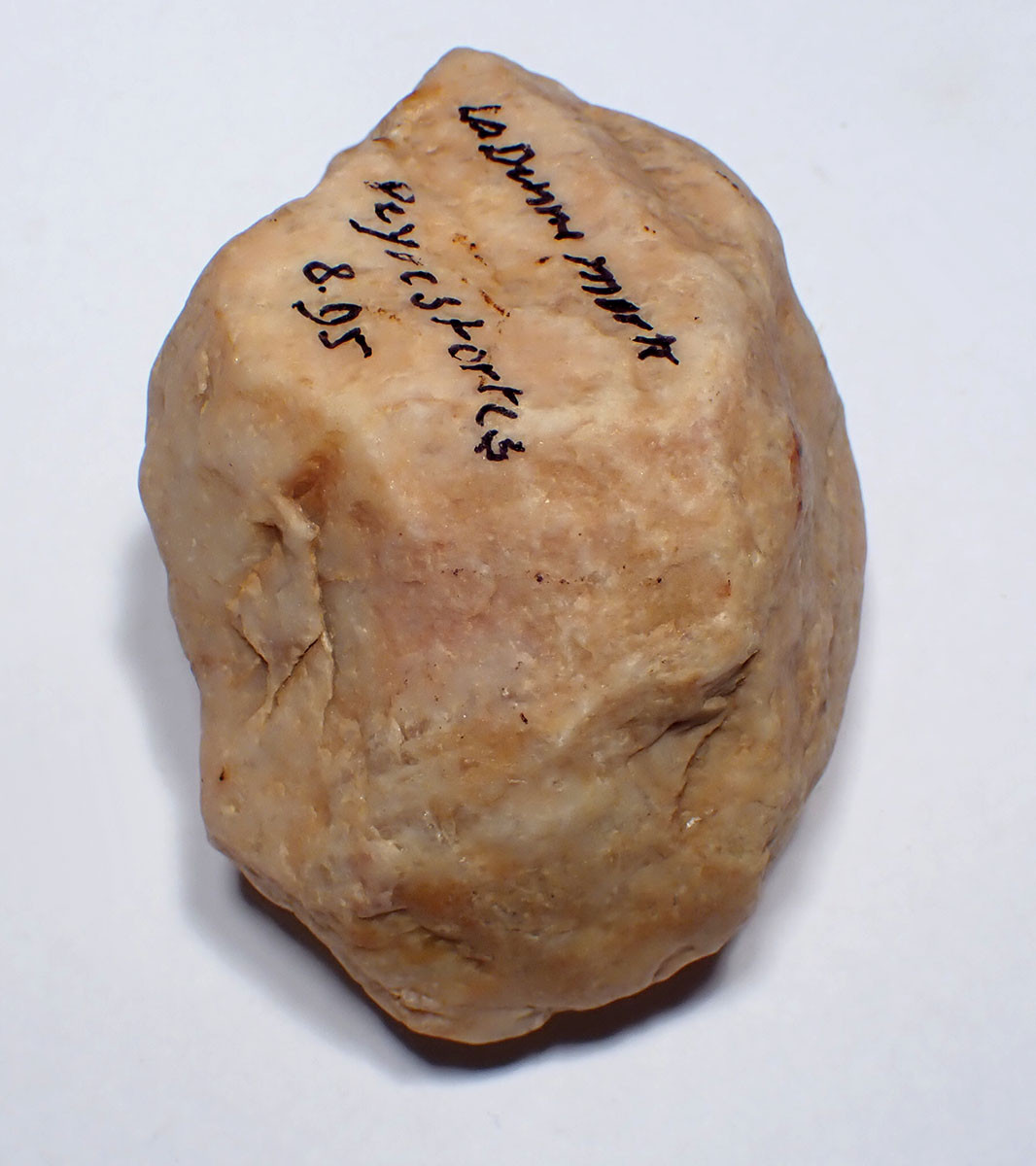
This Early Man Stone Age tool is a RARE, complete Lower Paleolithic Mode 1 pebble chopper made by Tautavel Man, a Homo erectus species that is classified as the oldest humans that first occupied what is now modern day France, well over 500,000 years ago. Found in the Pyrénées-Orientales department in southern France, this region has produced the famous human fossils of Tautavel Man, as well as numerous excavated stone tools of the Têt River terraces, which is part of the sedimentary basin of Roussillon, in the same area.
An intriguing discovery of Tautavel Man is that these humans practiced ritual cannibalism as opposed to cannibalism based out of the need to survive. Some humans bones discovered in the cave where Tautavel Man remains were unearthed, had been cracked open while still fresh. Others have cuts consistent with skinning and butchering, which attest to the practice of cannibalism. There was also an absence of chest, hand and foot bones. These would have remained if the individuals had been eaten by animals. It is believed the Tautavel humans specifically consumed brains, tongues, and the flesh and bone marrow of the limbs of the recently deceased or killed. This would indicate ritual cannibalism as opposed to survival cannibalism. Survival cannibalism would have utilized the entire body rather than only certain anatomy.
In the four decades we have been working with this material, we have never seen or heard of being able to acquire pebble tools from Tautavel Man. Nearly 25 years ago, we acquired a very SMALL collection of Tautavel Man pebble tools that remained in our private collection until now. Originally in a French private collection, and later a private Dutch collection dating back to the 1970s, these extremely scarce primitive human stone tools from France's first humans, pose an extraordinary opportunity to add a rare addition of the earliest human occupation of Europe to your collection.
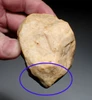
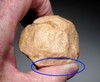
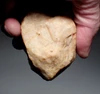
This quartz pebble tool was originally found in Canet-en-Roussillon, and is similar in type and lithic, to pebble tools shown in many scientific papers (see references below) that were also found in the lower terraces of the region. Based on the flaking and size, this is a reduced size pebble chopper that was flaked in several areas to fit deep in the hand. It has a blunt point on the distal end that shows evidence of use. A facet on the proximal end (see photos), would have made it comfortable to hold with the palm pressed against this area. A handwritten original collection label is still present on the stone.
Ancient mineral deposits and encrustations can be seen in all micro-crevices - a sign of authenticity and absence of any modern alterations. As further testament to its age and authenticity, the patina on all surfaces is heavy and well-deposited with no modern crushing.
HISTORY
Tautavel Man refers to the archaic humans which—from approximately 550,000 to 400,000 years ago—inhabited the Caune de l’Arago, a limestone cave in Tautavel, France. They are generally grouped as part of a long and highly variable lineage of transitional morphs which inhabited the Middle Pleistocene of Europe, and would eventually evolve into the Neanderthals (Homo neanderthalensis or Homo sapiens neanderthalensis). They have been variably assigned to either Homo erectus heidelbergensis, or as a European subspecies of Homo erectus tautavelensis. The skull is reconstructed based on the specimens Arago 21 and 47 (probably male). The brain capacity is 1,166 cc. They seem to have had an overall robust skeleton. Average height may have been 166 cm (5 ft 5 in).
The Caune de l'Arago opens on a cliffside 80 m (260 ft) above a river, overlooking the Tautavel plain, with a plateau above, and mountainous terrain to the sides. During and after human occupation, the area swung from temperate and humid forestland, to cold and dry steppeland. Stratigraphically, humans are present from beds Q–C. Bed G, dating to roughly 455,000 years old during a forested event, has yielded the most remains. They seem to have hunted a variety of animals, including red deer, fallow deer, argali, tahr, horse, reindeer, beaver, and the extinct narrow-nosed rhinoceros, among others. They made Acheulean stone tools, but mainly produced smaller retouched tools such as scrapers, rather than more iconic macro-tools such as bifaces (hand axes). In beds G and F, they may have been practicing ritual cannibalism. Evidence of fire is absent until bed C (400,000 years ago).
Considerable studies have been done on the early human habitation and excavated stone tools of the Têt River terraces, which is part of the sedimentary basin of Roussillon (Pyrénées-Orientales, France). Most research was performed between the late 1960s and early 1990s, the most famous being the discovery of Tautavel Man from the cave of Caune de l'Arago (Tautavel, France). An evolution of tool type was discovered between the earlier lower terraces, and the upper terraces. This typo-morphological study, based on collections from Jean Abélanet's surveys, shows the prevalence of the “chopper” pebble tools types from the middle terraces of the Têt. He notes that as time progressed,
ore recent the series, the more the chopping-tool disappears at the expense of the chopper (Collina-Girard, 1976). In addition, heavy tools are considered predominant, as are the polyhedral and discoid types. Finally, handaxes were present on the middle levels in only small proportions.
The objective of this current technicofunctional study, therefore, is to understand the perception that we have of these lithic assemblages from the Middle Quaternary terraces of the Têt River and, in particular, their place in the diversity and variability of the technical systems of the European Middle Pleistocene. This study, based on the analysis of 890 pieces from three localities (La Llabanère, Le Jas and Le Moulin à soufre), proposes a new reading of certain assemblages from the Roussillon Basin, which had previously been the subject of typo-morphological studies from a quantitative perspective. With a different methodological approach from previous studies, the present work contributes to the technological analysis of these open-air series in a fluvial terrace context. Moreover, the localities of La Llabanère, Le Jas and Le Moulin à soufre show that the Roussillon basin constitutes a relevant area for the study of human population dynamics and technical characteristics during the Middle Pleistocene, since it is positioned as a corridor between the Iberian world and the rest of the European continent.
WARNING: There are a host of these "prehistoric tools" for sale on Ebay and other websites where sellers have little to no information and understanding of Lower Paleolithic specimens. Many of these sources offer nothing more than damaged ancient river cobbles caused by environmental action (glacial disturbance, frost damage, etc.) or modern made fakes. Every broken cobblestone found is NOT a human-created Paleolithic tool! The determination of what is man-made and what is an ordinary broken river rock requires a very high level of understanding Paleolithic tool manufacture and technique as well as the experience to be able to differentiate the two and authenticate a genuine stone tool from this culture. Know your source and only deal with well-informed sellers who can help you understand the difference. All purchases should be accompanied by a written UNCONDITIONAL AND LIFETIME guarantee of condition and authenticity, as we provide.
REFERENCES
https://www.sciencedirect.com/science/article/abs/pii/S0305440303001377
https://en.wikipedia.org/wiki/Tautavel_Man
https://www.wikiwand.com/en/articles/Tautavel_Man
https://en.wikipedia.org/wiki/Pyr%C3%A9n%C3%A9es-Orientales
https://link.springer.com/article/10.1007/s41982-024-00195-x
https://www.sciencedirect.com/science/article/abs/pii/S2352409X2200222X
https://hal.science/hal-03015938/file/Pond%20de%20Lavaud%20JQS%20pour%20HAL.pdf
https://www.sciencedirect.com/science/article/abs/pii/S0003552115000394?via%3Dihub


