US DOLLAR
 EURO
EURO
 AUSTRALIAN DOLLAR
 CANADIAN DOLLAR
 POUND STERLING

Product Description
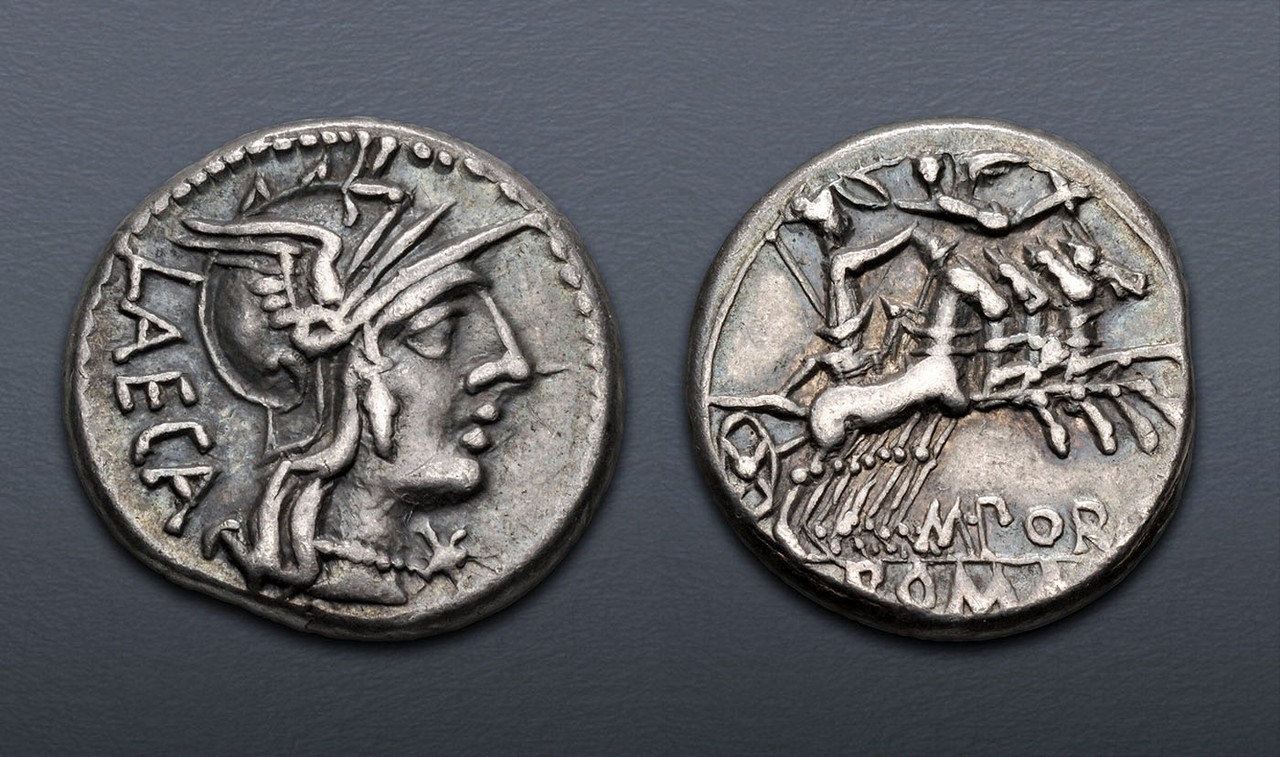
This genuine Roman Republic silver denarius ancient coin was minted in 125 BC, in Rome. It bears the name of the moneyer, M. Porcius Laeca. The obverse shows a helmeted head of the goddess Roma facing right, with a value mark below the chin. The reverse shows the goddess Libertas (goddess of liberty), driving a quadriga chariot to the right, and holding vindicta, reins and plieus, and the goddess Victory flying overhead and crowning Libertas with a laurel wreath. Crawford 270/1; Sydenham 513; Porcia 3: RBW 1088 - Attractive iridescent tone, a few minor marks under the tone. Very Fine.
HISTORY
The Roman Republic was founded in 509 B.C. and in its earliest times, was ruled by kings and chieftains. The Roman Republic was the era of classical Roman civilization beginning with the overthrow of the Roman Kingdom (traditionally dated to 509 BC) and ending in 27 BC with the establishment of the Roman Empire following the War of Actium. During this period, Rome's control expanded from the city's immediate surroundings to hegemony over the entire Mediterranean world. Roman society at the time was primarily a cultural mix of Latin and Etruscan societies, as well as of Sabine, Oscan, and Greek cultural elements, which is especially visible in the ancient Roman religion and its pantheon. Its political organization developed at around the same time as direct democracy in ancient Greece, with collective and annual magistracies, overseen by a senate. There were annual elections, but the republican system was an elective oligarchy, not a democracy, with a number of powerful families largely monopolizing the senior magistracies. In 27 B.C., the Empire was formally established with the title of "Augustus" given to its then ruler Octavian. From that point on, the emperor was referred to as "Augustus", his immediate heir "Caesar" and imperial wives were titled "Augusta".
Much of the success of the Empire can be attributed to the protection afforded by its near invincible war machine, the Roman army. Many tactics and weapons were first pioneered by this massive military force and just the thought of having to challenge this entity thwarted many a foreign enemy. Those that were brave (or foolish) enough to go up against Rome's military were quickly made examples of to the rest of the world. The technology and strength of the Roman military was the guardian of this great society for some 500 years.
The Roman Empire was a unique association of peoples and places such as the Mediterranean World had never seen before. What had been a patchwork of Hellenistic monarchies, independent city-states, and Celtic tribes was miraculously united into one great political entity. At its peak rule, the Roman Empire stretched from Spain to Syria and England to Egypt. Our modern world today benefits much from a host of technological innovations first given to us by the ancient Romans. From simple inventions such as blown glass and underground sewer systems to major concepts in engineering and the Roman calendar.