US DOLLAR
 EURO
EURO
 AUSTRALIAN DOLLAR
 CANADIAN DOLLAR
 POUND STERLING


Product Description
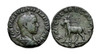
This genuine Roman Imperial bronze sesterius ancient coin was minted by Emperor Philip II from 247- 249 AD, in Rome. It is a special Secular Games Issue coin, minted to commemorate the 1000th anniversary of the Roman Empire. Philip's lineage was known for issuing Secular Games coins featuring various animals (lions, gazelles, hippos) that were killed in the Colosseum, marking Rome's 1,000th anniversary.
The obverse shows Philip I wearing a laurel crown and draped, facing right. The reverse shows a standing goat, one of the animals that was sacrificed in the Colosseum games to honor Rome's 1000th anniversary. RIC IV 264; Banti 16. Green patina. Very Fine.
HISTORY
The 200 years that began with Augustus's rule are traditionally regarded as the Pax Romana ("Roman Peace"). The cohesion of the empire was furthered by a degree of social stability and economic prosperity that Rome had never before experienced. Uprisings in the provinces were infrequent and put down "mercilessly and swiftly". The success of Augustus in establishing principles of dynastic succession was limited by his outliving a number of talented potential heirs. The Julio-Claudian dynasty lasted for four more emperors—Tiberius, Caligula, Claudius, and Nero—before it yielded in 69 AD to the strife-torn Year of the Four Emperors, from which Vespasian emerged as the victor. Vespasian became the founder of the brief Flavian dynasty, followed by the Nerva–Antonine dynasty which produced the "Five Good Emperors": Nerva, Trajan, Hadrian, Antoninus Pius, and Marcus Aurelius.
The Roman Empire was a unique association of peoples and places such as the Mediterranean World had never seen before. What had been a patchwork of Hellenistic monarchies, independent city-states, and Celtic tribes was miraculously united into one great political entity. At its peak rule, the Roman Empire stretched from Spain to Syria and England to Egypt. Our modern world today benefits much from a host of technological innovations first given to us by the ancient Romans. From simple inventions such as blown glass and underground sewer systems to major concepts in engineering and the Roman calendar.