US DOLLAR
 EURO
EURO
 AUSTRALIAN DOLLAR
 CANADIAN DOLLAR
 POUND STERLING






Product Description
SEE MORE ANCIENT ASIAN ARTIFACTS
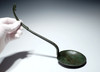
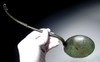
Dating from 1000 BC to 100 AD, the Dong Son culture is believed to be Asia's first civilization for ancient bronze casting. This MUSEUM-CLASS ceremonial sacred serving ladle is complete with the finest preservation. Supremely crafted by the lost-wax casting method that that ancient Lac Viet people had mastered, this impressive ritual implement was likely used in religious offering rituals to the spirits or in blessing ceremony of fertility or honor. We know the meaning of some of the Dong Son religious practices from the art depiction on their large bronze drums that played a central part in their religion.
In perfect, complete preservation, this remarkable dipper ladle has a wonderful upturned handle, ending in opposing spiral scroll work. Rich and colorful ancient encrustations compliment the exceptional preservation of the bronze surface.
Requiring great skill in their crafting, these ancient Dong Son bronzes demonstrate a highly developed and artistically talented society that once thrived in ancient Southeast Asia. Objects like these were reserved for wealthy and noble class citizens of this culture, as well as played an important part in their religious ceremonies and rituals.
This genuine ancient metal object has been professionally cleaned and conserved in our lab, the metal treated to protect against corrosion. Caution when acquiring UNTREATED ancient metal objects as they are extremely hygroscopic (attract moisture from the atmosphere), and are highly prone to corrosion and severe deterioration, over time. Every metal antiquity we sell is always cleaned and conserved in ways that exceed museum standards, to protect and preserve the object for the future. This is extremely rare in the public antiquity market.
HISTORY
The Dong Son culture (named for Đông Sơn, a village in Vietnam) was a Bronze Age culture in ancient Vietnam centered at the Red River Valley of northern Vietnam from 1000 BC until the first century AD. It was the last great culture of Văn Lang and continued well into the period of the Âu Lạc state. Its influence spread to other parts of Southeast Asia, including Maritime Southeast Asia, from about 1000 BC to 1 BC.
The Dong Son people, who are also known as Lạc or Lạc Việt, were skilled at cultivating rice, keeping water buffalo and pigs, fishing and sailing in long dugout canoes. They also were skilled bronze casters, which is evidenced by the Dong Son drum found widely throughout northern Vietnam and South China.
The origins of Dong Son culture may be traced back to ancient bronze castings. The traditional theory is based on the assumption that bronze casting in eastern Asia originated in northern China. However, according to archaeological discoveries in Isan, Thailand in the 1970s, the casting of bronze began in Southeast Asia first. The Dong Son bronze industry has a local origin, equivalent in timing to the Gò Mun culture, 700-500 BC. This includes bronze axes, spearheads and knives. This was followed by daggers, swords, drums, and situla from 500-0 BC. Finally, Chinese seals, coins, mirrors and halberds appear in the first century AD.