 US DOLLAR
 EURO
EURO
 AUSTRALIAN DOLLAR
 CANADIAN DOLLAR
 POUND STERLING









Product Description
SEE MORE EUROPEAN BRONZE AGE ARTIFACTS
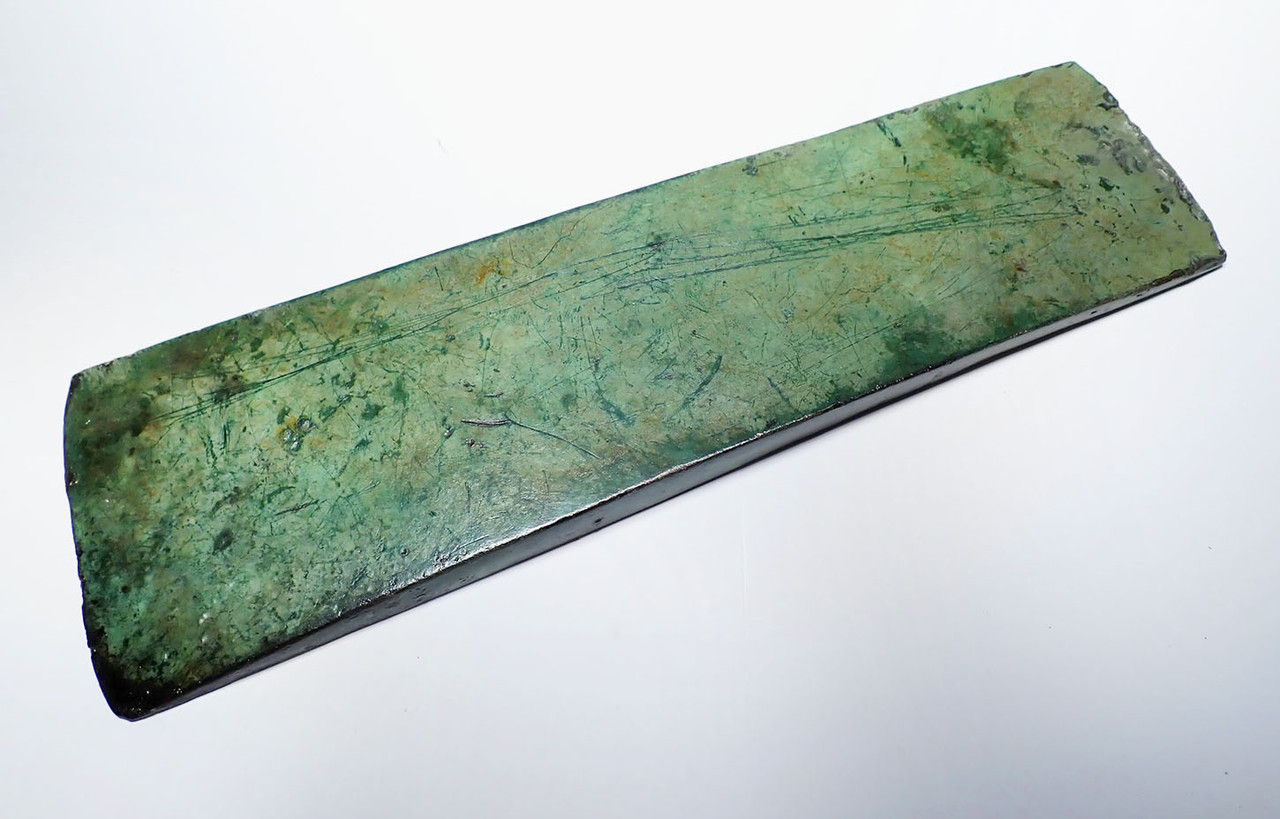
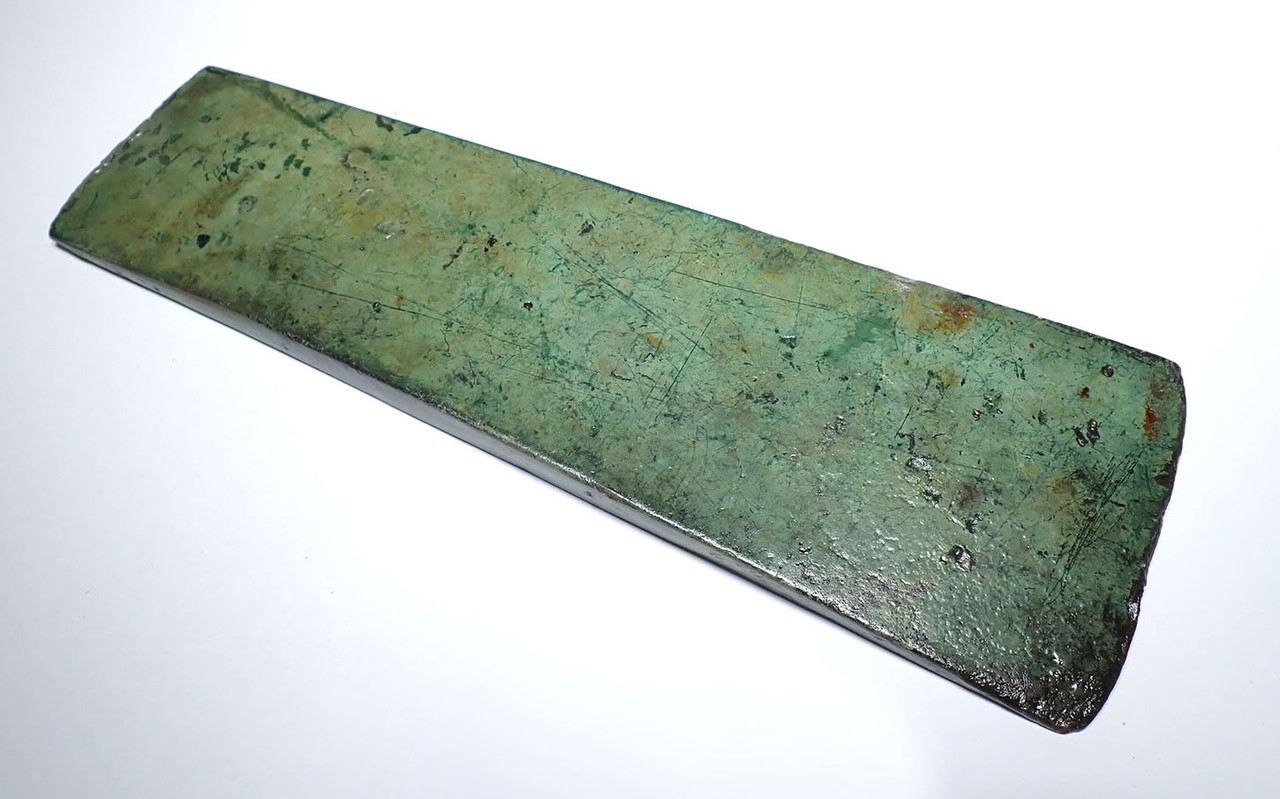
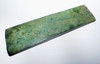
The legendary stone and wood architectural achievements in the ancient world, were made possible with major fundamental tools such as this - the earliest design of Bronze Age axes - the flat axe. In the Bronze Age, any object in bronze was rarely affordable to the common person but large items like this were so costly that they were entirely out of the reach of everyone except for the most wealthy members of society, royalty or noble lineage persons. The first design in the metal age, going back to the Copper Age that preceded the Bronze Age, the cast flat axe was the very earliest of types known. The vast majority of Bronze Age flat axes were small enough to lash to a wooden handle and use with one hand by your average person. This massive, MUSEUM-CLASS specimen is clearly well beyond being considered to be a one-handed type, not to mention what it would have cost in the Ancient world. When axes approach this size, and they are EXTREMELY RARE in their existence today as they were thousands of years ago, they are most often ritual objects and seen in royal, noble-class burials, or as objects of extreme sacrifice for a monumental ceremonial application. This is true of all Bronze Age societies but making this example especially rare if the fact that it comes from Bronze Age Europe. Bronze axes were often viewed as currency or as items of wealth storage. An axe of this magnitude from the Bronze Age would represent a enormous sum of money and riches to its owner.
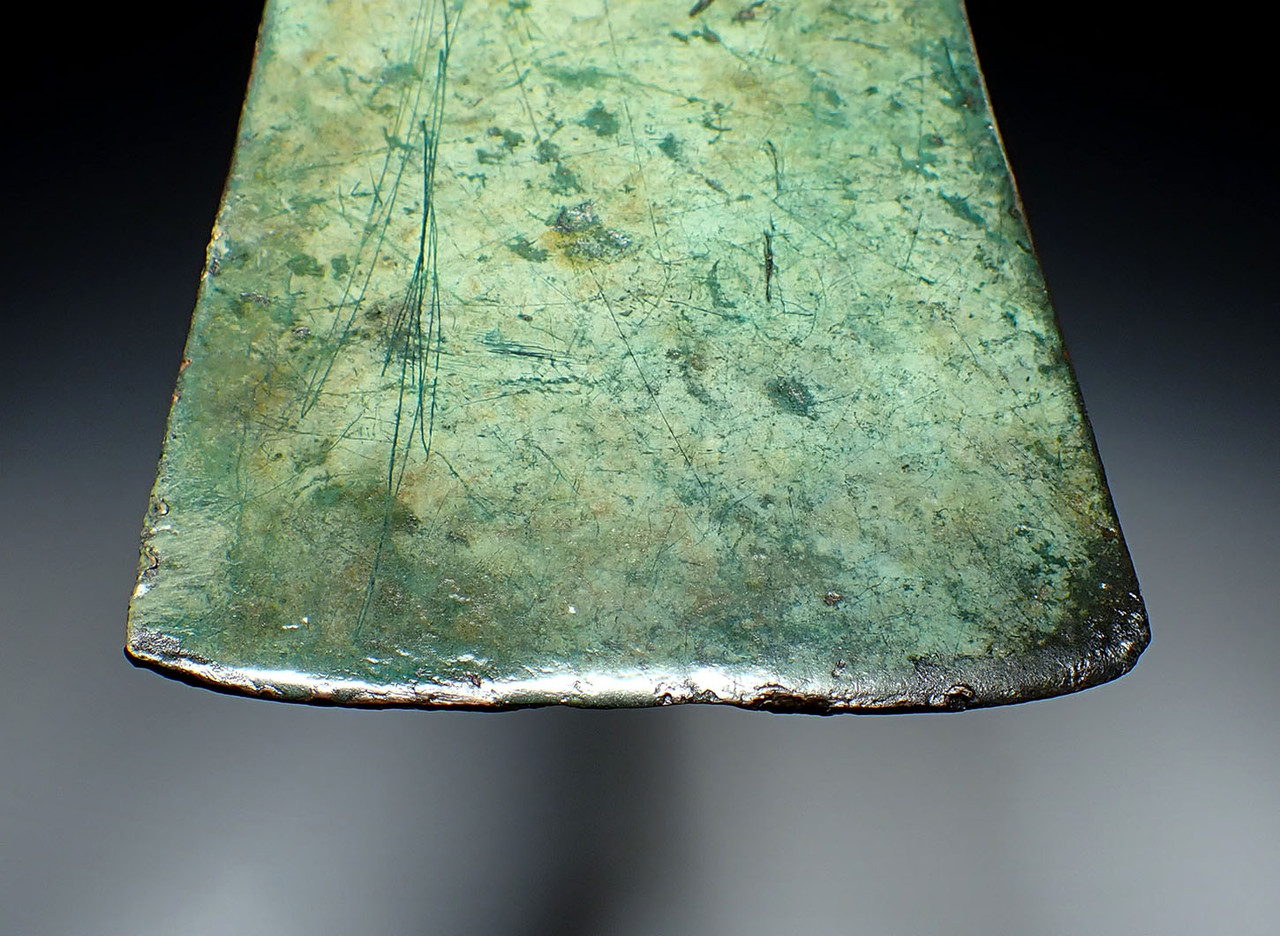
Unique to ancient bronze objects of Bronze Age Europe, is the remarkable smooth, almost surreal patina the bronze develops compared to ancient bronzes from all other corners of the world. There seldom is any bronze disease, or heavy encrustation or roughness to the metal surface due to corrosion or deterioration, as are often seen in ancient bronze items from Asia, the Near East or the Americas. The chemistry of the soil in Europe is perfect for producing mesmerizing bronze patinas and this huge flat axe is no exception. The microscopic encrustation patina almost looks like it was airbrushed on with its incredible variations of color from mint green to a deeper grass green. Having come from a private collection from England that dates back nearly 80 years ago, some handling scuffs can be seen in the patina but the overall condition of the specimen is truly MUSEUM GRADE. In nearly 40 years of us working with ancient objects, this is the finest and largest European Bronze Age axe we have handled, owned, or ever offered to our clients. Use wear is evident on the chopping end as is also evident on the butt end. Its weight is nearly 3 lbs (1.3 kg). It's length is 9.8" (~25 cm).
The state of preservation is incredible on this specimen - the absolute finest possible patina with mineral encrustations of which European Bronze Age antiquities are so prized for. Of all the ancient bronze objects in the world, these European Bronze Age objects display the most spectacular patina when everything is perfect as in this case!
Cleaned and treated in our lab to protect and preserve the integrity of the metal and allow safe handling. Unlike most metal artifacts sold on the market that are untreated and uncleaned, our specimens our properly cleaned, inspected and conserved in our museum conservation lab prior to being offered for sale to our clients. If ancient metal is NOT treated and stabilized correctly, IT WILL CONTINUE TO DISINTEGRATE AND CORRODE, AND COULD EVENTUALLY FALL APART.
Be wary of modern copies that plague the antiquity market today. We subject every artifact we offer for sale to rigorous inspection and authentication in our own museum lab facility.
HISTORY
The Tumulus culture dominated Central Europe during the Middle Bronze Age (c. 1600 to 1200 BC). It was the descendant of the Unetice culture. Its heartland was the area previously occupied by the Unetice culture besides Bavaria and Württemberg. It was succeeded by the Late Bronze Age Urnfield culture. The Tumulus culture was eminently a warrior society, which expanded with new chiefdoms eastward into the Carpathian Basin (up to the river Tisza), and northward into Polish and Central European Únětice territories. The culture's dispersed settlements centred in fortified structures.
As the name implies, the Tumulus culture is distinguished by the practice of burying the dead beneath burial mounds (tumuli or kurgans). The Tumulus culture was prevalent during the Middle Bronze Age. Tumuli have been used elsewhere in Europe from the Stone Age to the Iron Age yet, the term "Tumulus culture" specifically refers to the South German variant of the Bronze Age.