 US DOLLAR
 EURO
EURO
 AUSTRALIAN DOLLAR
 CANADIAN DOLLAR
 POUND STERLING








Product Description
SEE MORE ANCIENT NEAR EASTERN ARTIFACTS
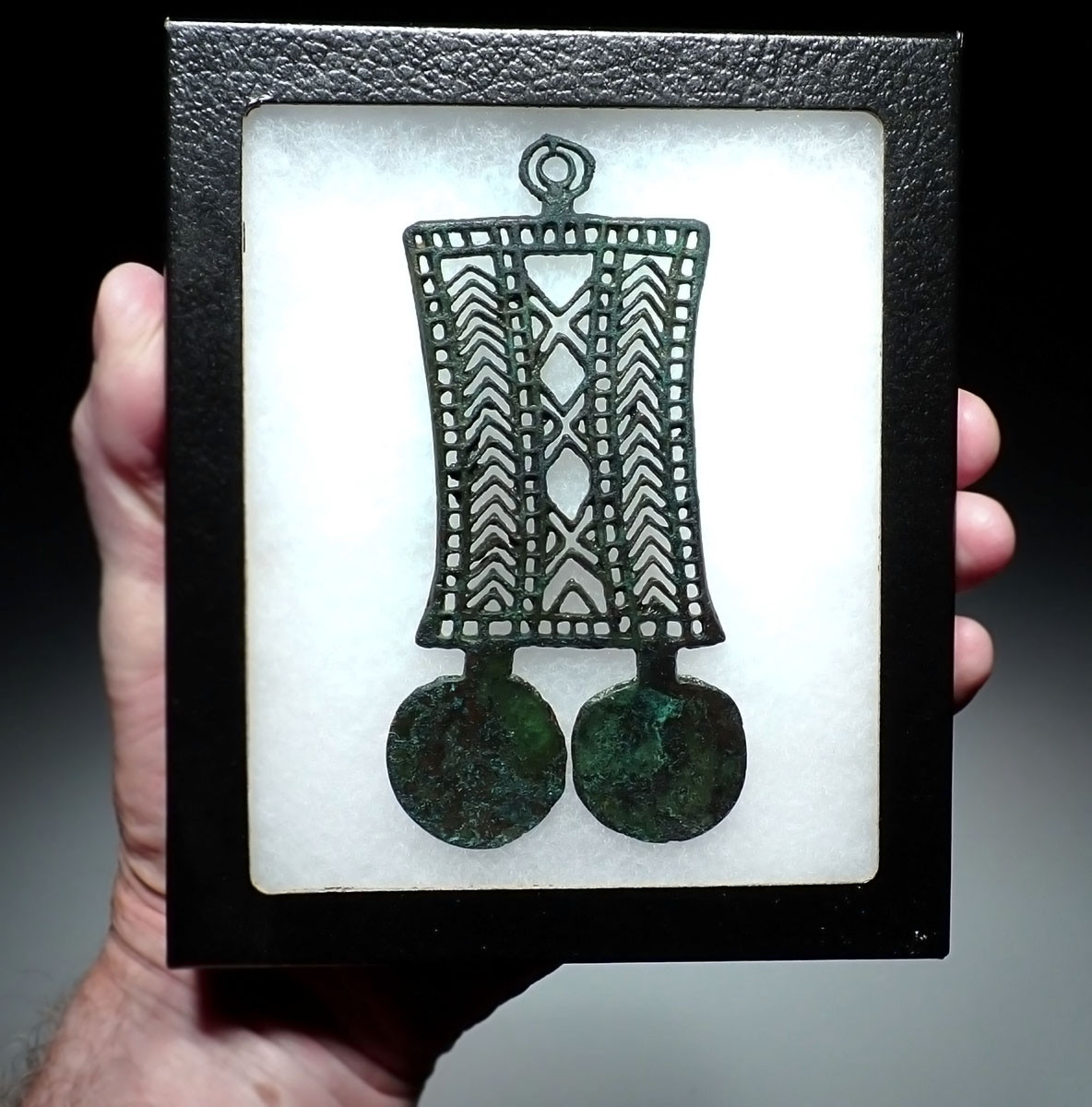
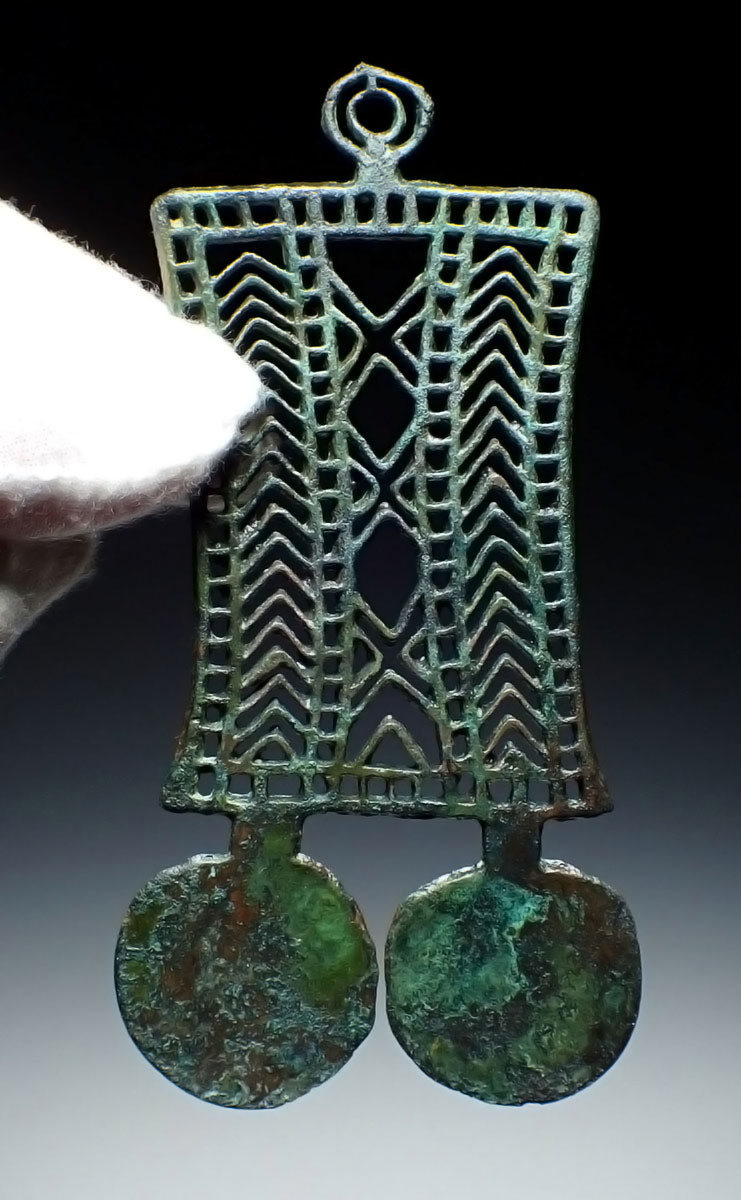
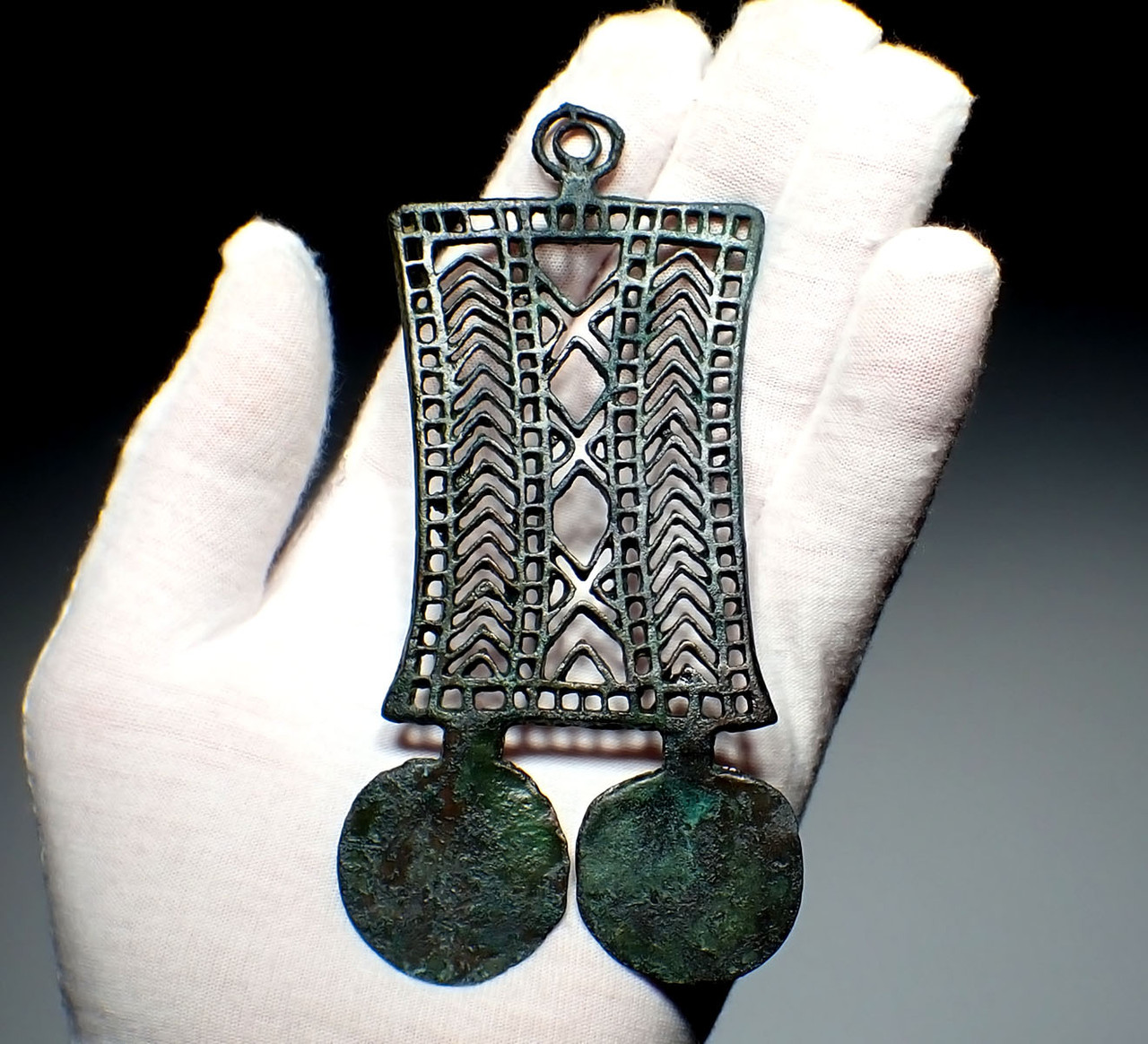
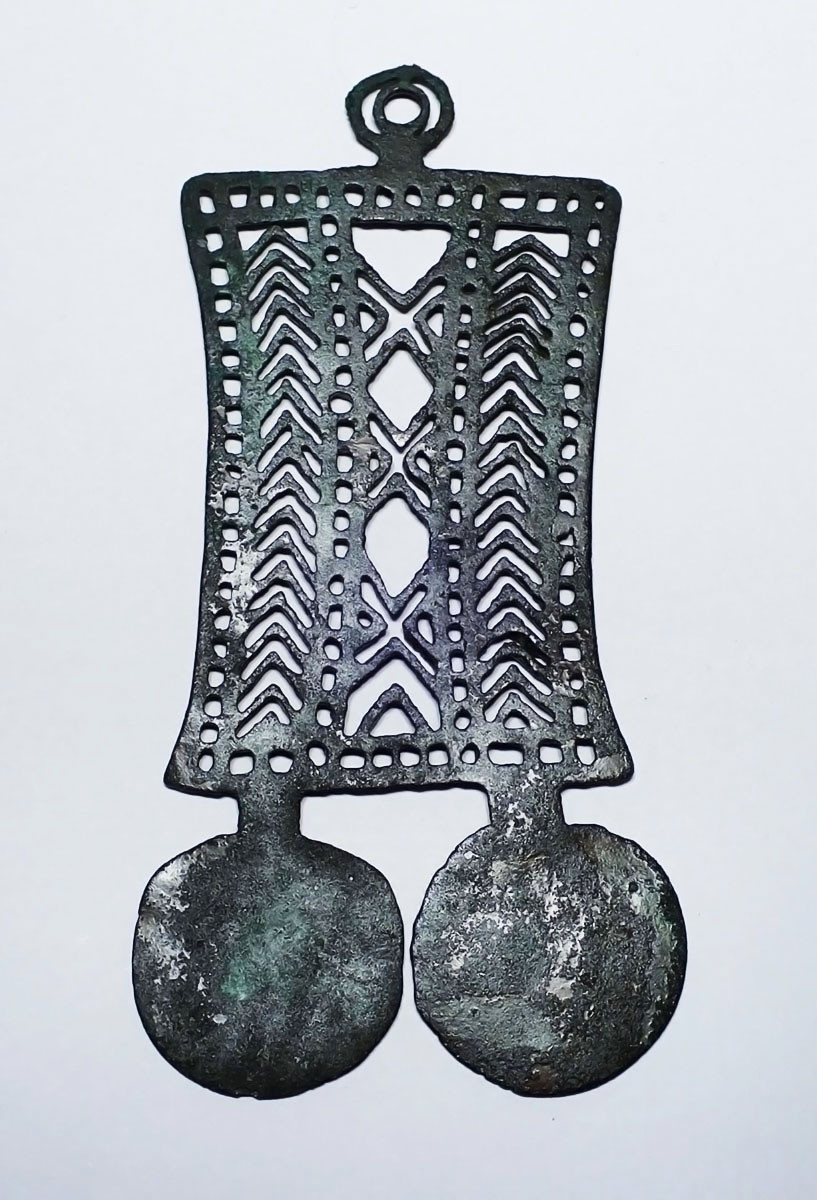
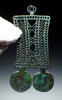
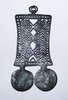
This is a genuine EXTREMELY RARE and EXQUISITE bronze ancient tribal clan badge from the Saka Scythian nomadic horseback warriors of the ancient Near East . It is the most elaborate and intricately designed example we have seen of all published types. Clan badge pendants like these would have been attached to warrior's clothing and to the horse armor and saddle blankets. They were a way of identifying with a specific clan or tribe in ancient times, and their symbolism helped to identify each other from friend or foe, in times of heated combat. Various types of ancient art of the Near East can be seen with horseback warriors riding horses clothed in cloaks and saddle blankets decorated with these abstract clan badge symbols. Most were made of hammered sheet metal and have rarely survived but this specimen is made from cast bronze, hence its incredible preservation and perfect, intact condition!
Images of these badges can be seen on ancient rock carvings in Iran. See the Men-at-Arms publication "Rome's Enemies (3) by Peter Wilcox, for more references and images.
Many ancient Near Eastern clan tribal badges featured a circular design in their appearance but this example takes it to the extreme with a very fine open geometric woven design of alternating bars in a complex shield-shaped rectangle just above two circles. Its ancient origin was one of being made in the lost-wax casting method. The very fine detail to the face would have required the most skilled crafts person to be able to carefully carve such fine, linear detail and then have such fine detail fully fill in the mold during the casting process. The surface shows colorful malachite and azurite mineral encrustations to attest to its age.
This is a true museum-class antiquity of both ancient tribal art and ancient jewelry. In the past two decades, we have never offered any object like this and out of a very large collection of many of the finest pieces we ever saw, it was the ONLY one of its kind!
This artifact has been professionally cleaned and conserved in our lab, being treated with a special sealer developed and formulated by us specifically for ancient metal preservation. The patina shows beautiful traits only found in authentic ancient weapons. It is a patina like this that the finest ancient bronzes are prized for and it is a patina like this that brings a premium in price and value of the specimen. There is no active bronze disease. Bronze disease forms a corrosive powder that will literally eat away an artifact over time and destroy it.
WARNING: There is a STAGGERING number of fake bronze weapons on the market. Many being sold as "authentic" were never meant to deceive and were made as far back as 100 years ago as exact reproductions for museums to sell in their gift shops. Other examples are modern fabrications specifically intended to fool unwitting buyers. As fine quality intact, original specimens become more scarce, the techniques to fake these objects have become highly advanced. We have personally handled numerous well-done fakes with extremely convincing patinas. The degree to which the fakers have been able to replicate patina to disguise their work requires an expert examination by highly experienced individuals. It is common to find very reasonably priced weapons that are made up of part original and part modern components or wholly modern pieces displaying elaborate artificial patinas. All purchases should include a written guarantee of authenticity from the seller, with unconditional and lifetime return policies regarding such guarantee, such as we provide.
HISTORY
The Scythians, also known as the Pontic Scythians, were an ancient Eastern Iranic equestrian nomadic people who migrated during the 9th to 8th centuries BC from Central Asia to the Pontic Steppe in modern-day Ukraine and Southern Russia, where they remained until the 3rd century BC.
Skilled in mounted warfare, the Scythians displaced the Agathyrsi and the Cimmerians as the dominant power on the western Eurasian Steppe in the 8th century BC. In the 7th century BC, the Scythians crossed the Caucasus Mountains and often raided West Asia along with the Cimmerians.
In the 6th century BC, they were expelled from West Asia by the Medes, and retreated back into the Pontic Steppe, and were later conquered by the Sarmatians in the 3rd to 2nd centuries BC. By the 3rd century AD, last remnants of the Scythians were overwhelmed by the Goths, and by the early Middle Ages, the Scythians were assimilated and absorbed by the various successive populations who had moved into the Pontic Steppe.
After the Scythians' disappearance, authors of the ancient, medieval, and early modern periods used their name to refer to various populations of the steppes unrelated to them.
While the ancient Persians used the name Saka to designate all the steppe nomads and specifically referred to the Pontic Scythians as Sakā tayaiy paradraya, lit. 'the Saka who dwell beyond the (Black) Sea'),[35] the name "Saka" is used in modern scholarship to designate the Iranic pastoralist nomads who lived in the steppes of Central Asia and East Turkestan in the 1st millennium BC.
Like the nomads of the Chernogorovka-Novocherkassk complex, the Scythians originated, along with the Early Sakas, in Central Asia and Siberia in the steppes corresponding to either present-day eastern Kazakhstan or the Altai-Sayan region. The Scythians were already acquainted with quality goldsmithing and sophisticated bronze-casting at this time, as attested by gold pieces found in the 8th century BC Aržan-1 kurgan.
The second wave of migration of Iranic nomads corresponded to the early Scythians' arrival from Central Asia into the Caucasian Steppe, which begun in the 9th century BC, when a significant movement of the nomadic peoples of the Eurasian Steppe started after the early Scythians were expelled from Central Asia by either the Massagetae, who were a powerful nomadic Iranic tribe from Central Asia closely related to them, or by another Central Asian people called the Issedones, forcing the early Scythians to the west, across the Araxes river and into the Caspian and Ciscaucasian Steppes.
This western migration of the early Scythians lasted through the middle 8th century BC, and archaeologically corresponded to the westward movement of a population originating from Tuva in southern Siberia in the late 9th century BC, and arriving in the 8th to 7th centuries BC into Europe, especially into Ciscaucasia, which it reached some time between c. 750 and c. 700 BC, thus following the same migration path as the first wave of Iranic nomads of the Chernogorovka-Novocherkassk complex.